Part 7. The end of the road for Sir Thomas, but not for Lipton
In our last Newsletter, we left Sir Thomas busily contributing to the war effort and Shamrock IV, built in 1914, safe in her wartime berth in Brooklyn. The Lipton Company prospered during the war as Sir Thomas maintained his usual high public profile, tirelessly campaigning and fund raising around the country for the Tank Bank, which built thousands of the new-fangled machines that helped shorten hostilities. Despite wartime food rationing, Lipton managed to return dividends to shareholders at pre-war levels.
Lipton fully intended to continue his quest for the America’s Cup. He joked with reporters that he “had to drink his tea from a saucer” as he was unable “to lift the cup”. In 1920, the first race of the post war series lined the snub-nosed, green-hulled Shamrock IV against the American yacht Resolute. Tens of thousands of spectators took to the water to watch the race amidst a media circus; reporters chased the yachts in a US Navy airship, and events were transmitted across the Atlantic within minutes by “wire-photo” – an early form of fax. The rules required that Resolute be allowed a seven minute start on Shamrock IV due to the latter’s larger sail area. Nevertheless, Shamrock won the race, mainly due to Resolute breaking a mainsail halyard. Characteristically, Sir Thomas refused to celebrate a victory based on an accident. But to wild acclaim, even from Americans, Lipton also won the second race, finishing nine minutes ahead, or twominutes with the handicap. To take home the Cup however, Shamrock IV needed a third win – and in this race, though pipping Resolute by half a minute, the result went to Resolute on the handicap, as did the fourth race. With a decider to sail for, the fifth race was postponed by the judges due to rough weather – which Shamrock IV was built for. Next day, extreme calm favoured Resolute and she won convincingly. This was the closest Lipton, or indeed anyone, had so far come to wresting the Cup from America. But the Americans loved his sportsmanship, and in the 3 days after the final race, 35,000 people flocked to visit Shamrock IV in dock.
Lipton was to mount just one more challenge for the elusive Cup. The keel of Shamrock V was laid in 1929 to the new J-class rules hammered out after years of negotiation on America’s Cup yacht design. Shamrock V was a fast and graceful vessel but the US defender Enterprise incorporated latest aircraft technology and ergonomics into its build, and obsessive man management into its crewing. Despite what seemed to be the entire US nation willing Lipton to win, the races went in favour of Enterprise. Film star Will Rogers, in his weekly newspaper column, urged Enterprise’s captain, Mike Vanderbilt, to give Lipton a win “if Vanderbilt wants to make himself an American hero.” But Vanderbilt was driven by competition rather than by popularity – and Shamrock V was well defeated. A wave of emotion swept America, which had turned to sport to relieve the ache of the Great Depression. Many Americans argued for the Cup to be presented to Sir Thomas anyway. Will Rogers called for a loving cup to mark Lipton’s five unsuccessful events. Franklin D Roosevelt – then a State Governor – sent a donation with the message “Sir Thomas and his good sportsmanship are a lesson to every American.” Silver miners in Utah sent 25kg of silver which was used by Tiffany’s to form the base for a solid gold loving cup – the Lipton Trophy. New York Mayor Jimmy Walker suggested the inscription: “To possibly the world’s worst yacht builder, but absolutely the world’s most cheerful loser.” Later that year, in New York’s City Hall, Sir Thomas, with uncharacteristic tears, received the trophy with accolades from Mayor Walker. He was now 82 years old.
Although Lipton had captained his company well during the war years and soon afterwards returned good dividends for shareholders, the commercial waters had become choppy by the mid-1920s. The chain of 500 Lipton shops that had before seen no real competition were now facing new rivals: Sainsbury’s, Home and Colonial, David Greig’s and Maypole were fast becoming household names. Sir Thomas Lipton, whose autocratic methods had worked well in building the company, could not adjust to the rules of corporate management – he had no tolerance for less than perfect and was often arbitrary in his decisions. Lipton was Managing Director and still the largest shareholder but despite that, the Lipton Ltd annual meeting of 1926 was stormy: his fellow directors forced him out of control by promoting him sideways to the ineffectual position of “Life President and Chairman”. Lipton resisted retirement for six months but finally agreed to depart, having negotiated sale of his shares to the Van den Burgh group for a seven figure termination fee that would drop the jaw of even a modern banker.
Thereafter Sir Thomas concentrated on his wholly-owned American companies, managing them in his accustomed style. His office was at the top of the huge Lipton warehouse on the Hudson River at Hoboken, New Jersey. This had a car-sized lift and Sir Thomas would be chauffeur driven into the lift and whisked to his office, stepping out of his car and straight to his desk. It was from this office in 1930 that he masterminded his last challenge for the America’s Cup.
Sir Thomas died at home from a respiratory infection in the summer of 1931 just eight months after receiving the golden loving cup from his American admirers. He bequeathed Osridge, his London home of fifty years, to be used as a retirement home for nurses. His 84 volume scrapbook of press cuttings and photographs recording his amazing life, his yachting trophies, and the remains of his fortune – almost a million pounds – he donated to the sick and poor of Glasgow. The gold Lipton Trophy loving cup he deeded back to the New York Yacht Club.
His iconic name lives on in the tea brand that globally still outsells all others, yet it is not retailed in the UK. How can that be?
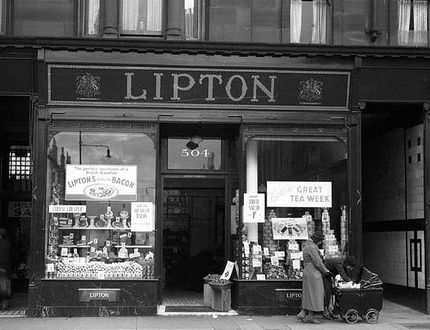
The chain of Lipton grocery stores of UK Lipton Ltd were merged in 1929 with Home and Colonial Stores to form a 3,000 shop chain of grocers and tea merchants. Home and Colonial traded until 1961 when, to reflect the passing of the British Empire, it rebranded itself as Allied Suppliers. The Lipton store name continued in the UK as a small town supermarket chain until it was acquired first by the Cavenham Group in 1972, and then the Argyle Group in 1982 who rebranded Lipton stores as Presto when Argyle merged with Safeway UK.