Category Archives: Tea Talk

Tasting Lumbini Teas

Today we started tasting the tea samples I brought back from World Tea Expo 2014.

They are from the Lumbini Estate in Sri Lanka. It is a beautiful looking factory nestled in woodlands (the Sinharaja forest reserve).

image

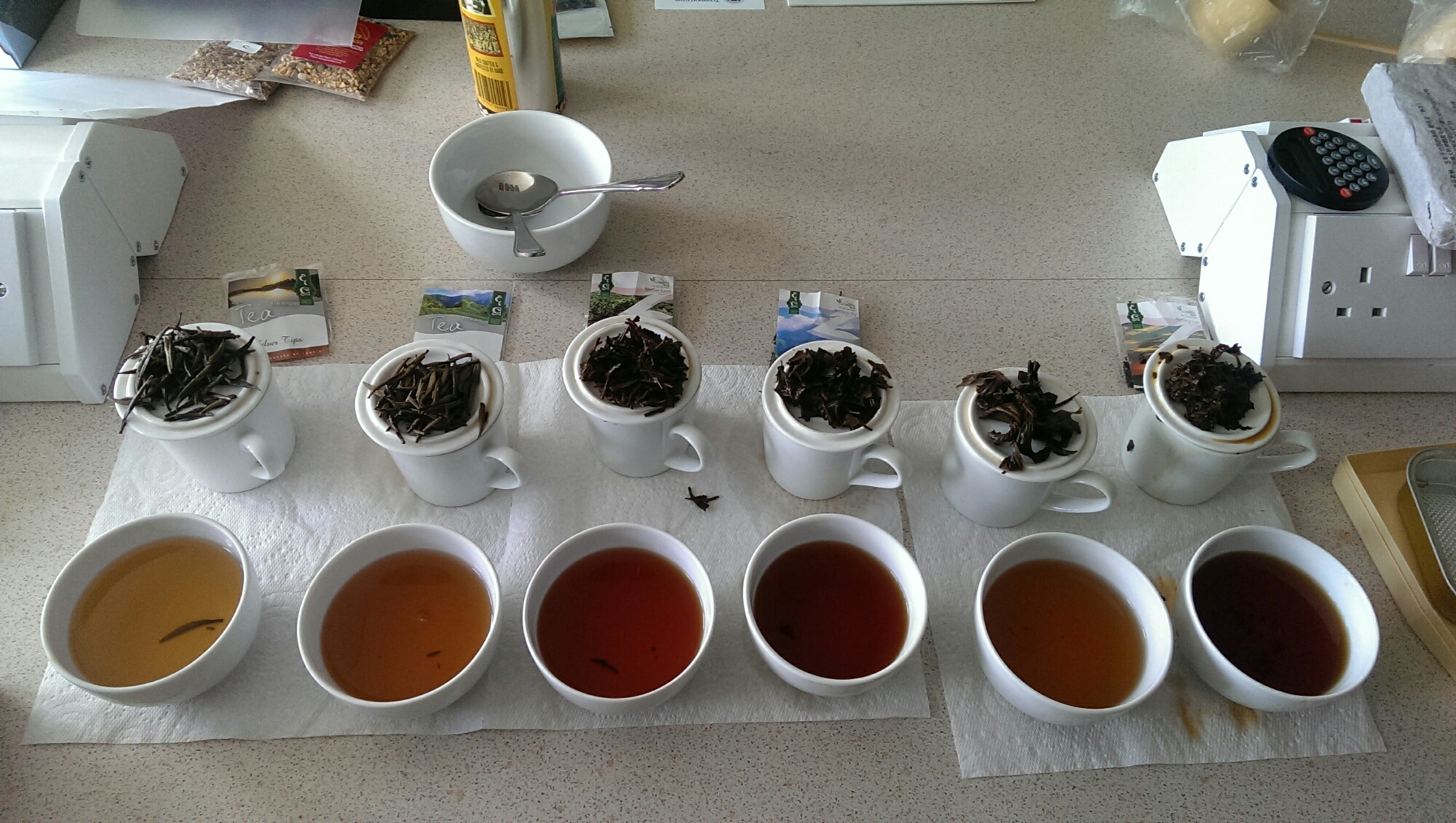
Teas left to right.

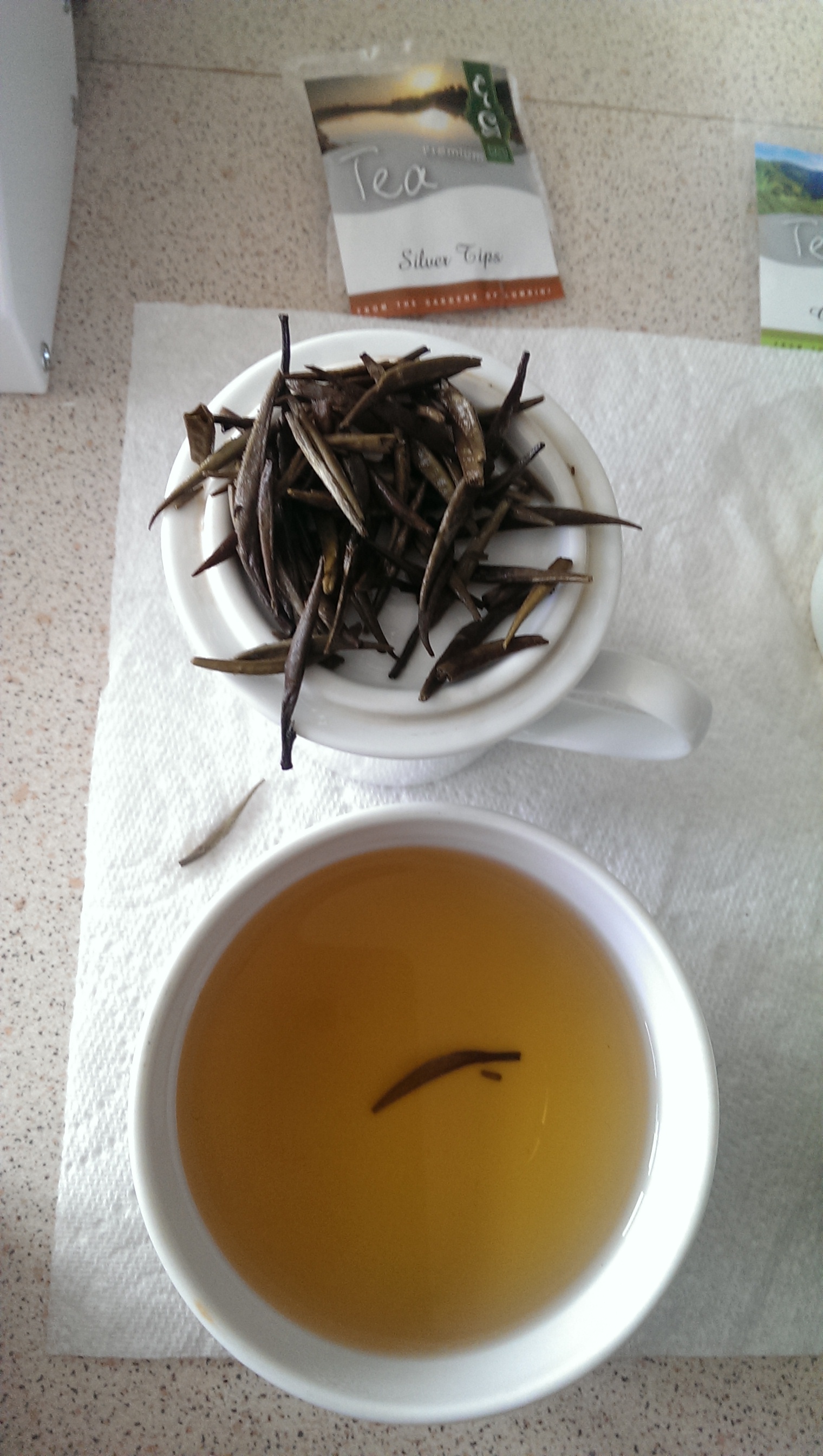
Silver tips
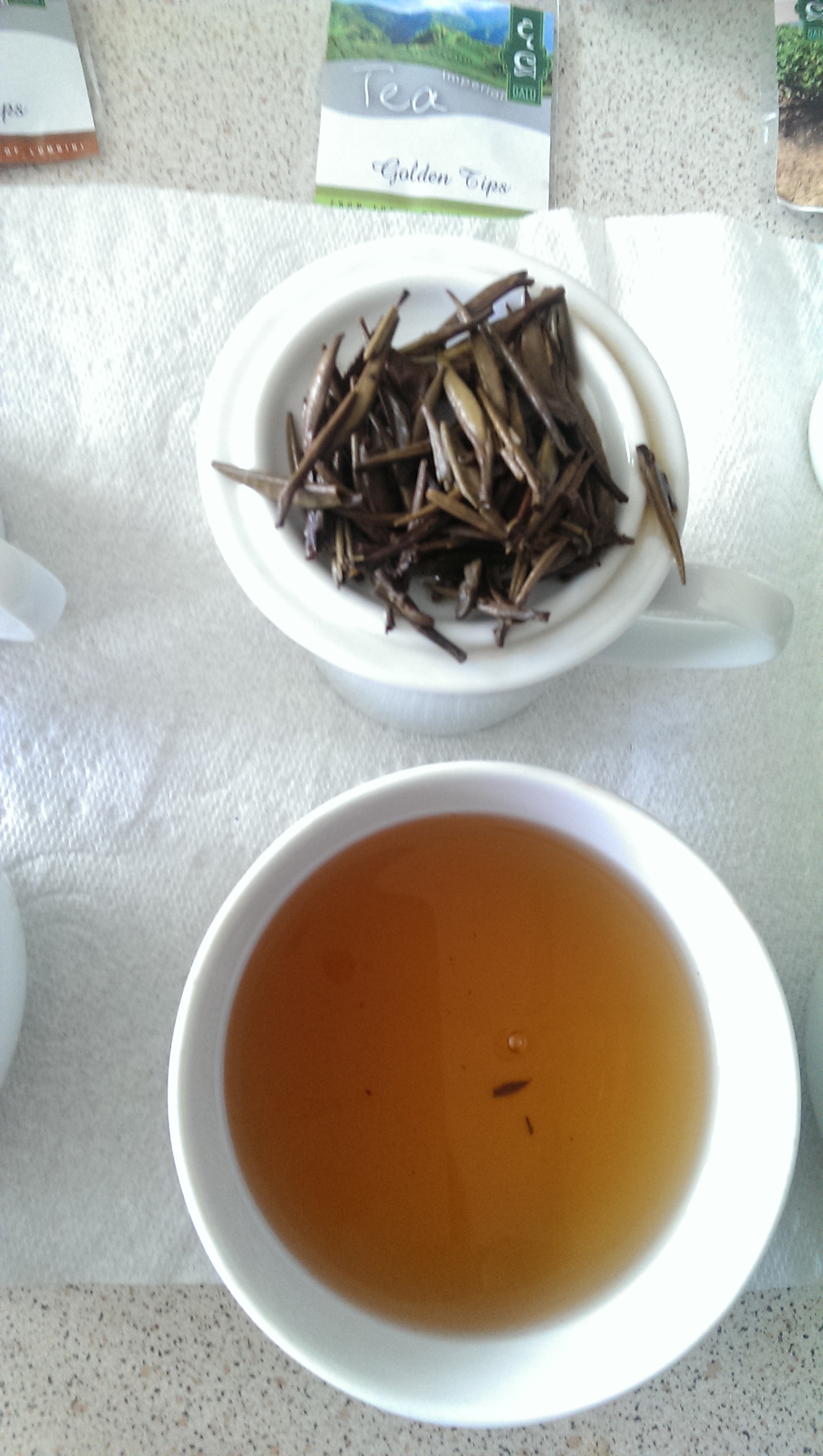
Golden tips
Mother earth OP1
Endless sky FBOP
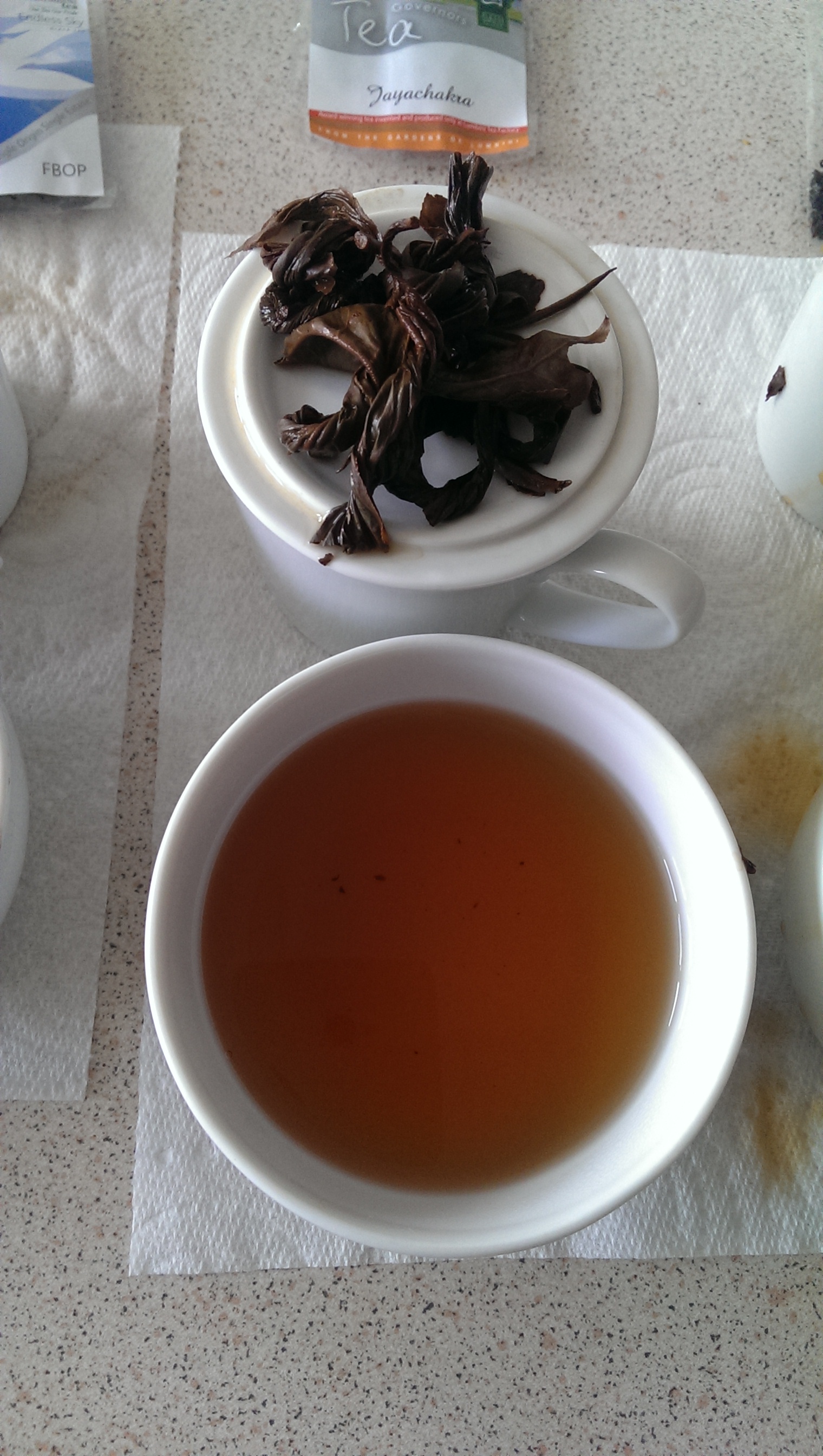
Jayachakra
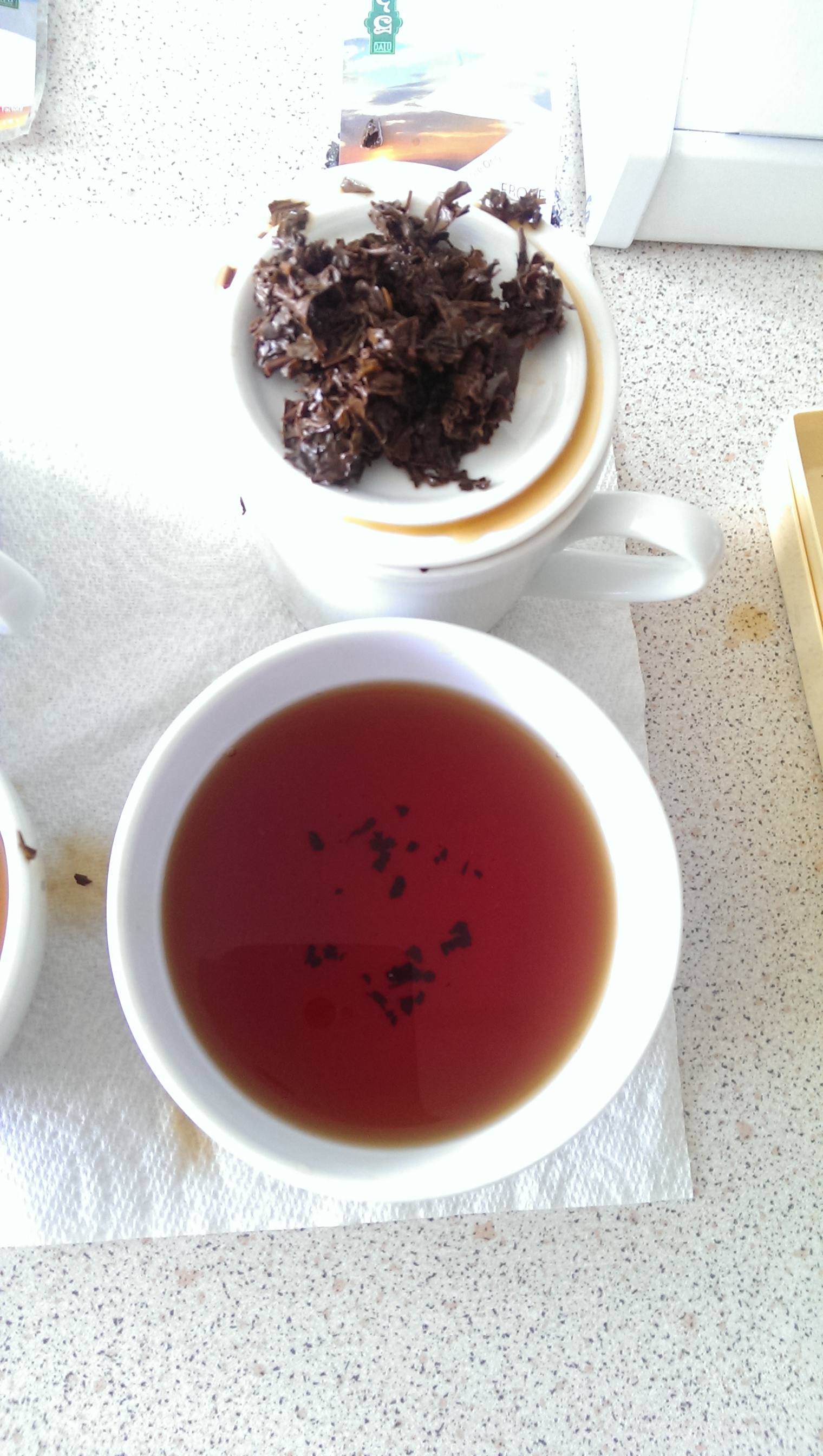
Burning Sun FBOPF

I’ve not tasted a good Ceylon Silver Tips for a few years now. So this was a real treat.

image

The Golden Tips were also good (the Roving Teaman preferred them over the Silver)

image

Mother Earth and Endless Sky were both excellent brews as well. Full of bright colours, crisp floral notes, and generally a delight to taste.

The Jayachakra tea is unique to the Garden. It is two whole leaves and a bud, formed carefully into a ring. It has a lighter colour and is a gentler infusion. It is a special tea, for special occasions when you have got the time to savour the flavours and bouquet.

image

Last but not least is Burning Sun. This is a pretty amazing brew. It is strong, would take milk if you wanted it, packed with flavour, yet gentle, not bitter, has great mouth feel. It has to be one of the best Ceylon’s we have tasted.

image

I can’t yet say that these teas are coming soon, though I do hope I can in the near future. You are going to love them.

Tea Tasting

Several boxes of tea samples where waiting for me this morning, and I found my tasting spoon. May be it is just me that gets like this, but tea tasting is just not right if I don’t have my spoon.

Today was a really good tasting day. Highlights include:

Yuan Shan Yin Zhen

An speciality from the Hunan province. Yellow Silver Needles. Which had a really interesting depth of flavours. It takes a lot of tea buds to make and is at the higher end of the tea price spectrum.

Next was a batch of oolongs

oolongs

All of which were very different colours in the cup. All of which were delicious in different ways. There was one from Nepal, one from Indonesia, China, Formosa and Thailand. All of which were delicious.

Tai Ping Hou Kui

I think this has to be one of the most visual teas I have come across. Looks amazing and tasted very interesting, with clean soft green notes, and a smokiness which smoothed the flavours together. Not an everyday green tea, but certainly would make a great end to a meal or be an afternoon highlight.

Last but not least was this tea,

Wild Tea Buds

Yunnan Wild Tea buds. These are harvested from wild tea trees. It does not look very interesting in the cup, the liqour is just a few shade away from looking like water. However it is packed with flavour yet light and clean and having just had a second cup cold would bf fabulous in the summer chilled. This is definitely one of my new favourite teas.

Now I just need to work out how I am going to get all these lovely new teas in the building!

TEA TALK: A Safari through Kenyan Tea

Kenya is perhaps best known around the world for its game parks and beaches – but the tea industry is a huge and important part of Kenyan economy and culture. A Kenyan safari may mean lions and zebra for some, but Safari means journey in the local Swahili language – and the most amazing journey in Kenya is through the unforgettable tea fields. Kenya vies with Sri Lanka for the most tea exported in the world, yet everyone has heard of Ceylon and India and China teas, while Kenya tea is not so well recognised.

Kenya is situated on the east coast of Africa, a tropical country straddling the equator, the warm Indian Ocean to the east, and huge fresh water Lake Uganda to the west. Note that fifteen other African countries are also tea producers large and small – though Kenya produces more tea than all the rest added together – last year topping 300,000 tonnes for the first time.

Tea is naturally a plant of the moist tropics. On the equator and at sea level the temperatures are far too hot for tea to grow. Fortunately, Kenya has plenty of high land on both sides of the Rift Valley where, at elevations from 4,500 up to 7,000 feet the air is cool and rainfall is plentiful; combined with the rich acid volcanic soils the intense natural light and high humidity, the conditions are ideal for tea. In Kenya the tea growing conditions uniquely combine quality with quantity. In the 400 square miles that are carpeted with tea there are over 1 billion tea bushes growing, and every one of those bushes is visited every ten days by a trained tea plucker who selects just the newly grown tips for harvest. No harvesting machines operate here – just human skill. At 1,500 tips per kilogram a plucker will select and pluck over 30,000 per day! The Kenya tea industry is vast and, because it is labour intensive, it can achieve the very best quality.

The ongoing peaks and dips in tea prices at the Mombasa auction affect a lot of lives. Out of Kenya’s 25 million population over 12% are involved in the tea industry in some capacity, and half a million are directly employed in producing tea. KTDA – the Kenya Tea Development Agency, is a huge co-operative of small tea farmers established in 1965 (before then only multinational companies were allowed to grow tea). Now KTDA has 430,000 individual farmers growing and selling green leaf to the 55 tea factories it manages. An amazingly complex and successful undertaking that operates effectively despite all the problems found in a developing country.

Kenya was a late comer into the world tea scene with the earliest commercial plantings made in the 1920’s – compare this with China’s 5,000 tea history, Indonesia from the 1700’s, Indian production from 1830, and Sri Lanka from 1870. Brooke Bond still pluck from the original bushes planted just north of Nairobi. Commercial production took off exponentially in the 1930’s and now Kenya teas feature in virtually all UK tea blends. Kenya’s spectacular export growth is the more impressive when compared with India for example where growth in exports has only been 20% in 70 years (160,000 tonnes exported annually in 1930’s and 210,000 tonnes per annum now). To support this spectacular and consistent growth the Kenya industry has pioneered and perfected many innovations in tea production, like the withering trough, continuous fermentation, the CTC and the fluid bed drier, and giant tea factories that give economy of scale.

Multinational companies grow about 40% of the Kenyan tea with small farmers under KTDA guidance growing the bulk. KTDA has 55 out of the total tea 98 factories. Kenya’s tea factories are on average four times as large as those in Sri Lanka and six times as big as those in Assam.

At the tea auction that is held in Mombasa every Monday and Tuesday, tea is sold by the producers and is bought by local and international packers. Big names Lipton, Brooke Bond, Van Rees are represented there, plus many small brokers and traders. Before the auction commences they will have seen and tasted tea samples from each of the lots and will bid for their requirements. Some 70% of Kenya’s tea passes through this auction with the remainder sold by private treaty. The Mombasa auction attracts tea from surrounding countries too – Uganda, Tanzania, Malawi, Burundi and Rwanda. All these are then shipped worldwide from Mombasa port for blending and packing in consuming countries.

Of the 300,000 tonnes of Kenya tea produced only 7% is retained for local drinking. For the rest there are three main customers – UK, Pakistan, and Egypt, who together purchase nearly three quarters. US consumption of Kenya tea is very small – of the 46 billion cups drunk in USA only 800 million are grown in Kenya. The main reason for this small uptake is that Kenya grows high quality CTC black tea. This is ideally suited to England’s “strong tea with milk and sugar” taste but is not so popular with Americans and most Europeans who drink their teas without milk. Prior to WW2 the US drank equal amounts of green and black tea of orthodox manufacture; but since then tastes have changed towards iced tea that now forms 70% of the US tea market.

With the rising popularity of the teabag Kenya has since the 1970’s (as has the rest of Africa) concentrated solely on black CTC tea – but globally this is fast becoming an oversupplied and stagnating market. KTDA is known for making the very best quality of CTC teas and has recently diversified into producing fine specialty leaf teas using traditional orthodox tea equipment imported from India.
TEA TALK: Getting to Grips with Japanese Tea

Japanese tea has many terms and names that are at first confusing – but understanding a little about its history and manufacture will enhance your enjoyment of the Japanese teas we offer.

Tea brought originally as seeds from China has been grown in Japan for over 800 years and a Japanese tea culture soon grew up, based originally on the ancient Chinese methods, utensils and traditions but, particularly during the 16th Century, was refined to reflect a period of flourishing Zen Buddhist based Japanese cultural development. The tea ceremony (Chanoyu), tea masters, tea schools (including Urasenke) and exquisite ceramic tea utensils date back to this time. Chado (The Way of Tea) then reached its purest form under the influence of artist Sen Rikyu (1522-1591) with its highly aesthetic and ritualised tea ceremony recognising the beauty of ordinary life. The basis of Chado is Harmony – expressed in four written characters:

Kei Reverence – respect for all things and beings

wa Harmony and Peace – deeply felt, honest sympathy with everything and everybody

sei Purity – inner and outer purity in thought, deed and word

jaku Quietness

When, by following the tea ceremony ritual, this state of Harmony is reached then the final goal – Tranquillity – is achieved.

Technically the history of Japanese tea has evolved through three main stages – Boiled Tea, Whipped Tea and Steeped Tea. Originally Japanese tea was made into compressed cakes for transport and storage – the tea at this time was manufactured as parched green tea using the technique learned in China. Cake tea was broken into pieces and boiled to reconstitute it. At some time in the 15th Century steaming was introduced and Japanese tea manufacture could then produce a very bright green product; eventually this crude leaf tea was powdered by grinding between stones instead of being pressed into cakes. This powdered tea (Matcha) was used for making Whipped Tea – frothed by whipping the powdered tea and hot water with a bamboo whisk. This is method still central to the tea ceremony. Finally, in the 18th Century a tea seller in Kyoto developed an entirely new method of rolling and rubbing steamed leaves by hand on a hot surface. The method produced needles of rolled leaf (Sencha) that retained a better flavour and colour and made possible the steeping of tea in a tea pot. Steeped tea developed its own much less formal ceremony (Sencha-do) which became particularly popular among literary artists who prized freedom under the hierarchical feudal system of the period.

Japan has many types of green tea the names of which reflect how the tea was grown, the type of leaves used in its manufacture, the method of manufacture, how the tea is sorted and any final processing it received. When you understand the meaning of these tea names it makes choosing a Japanese tea much more interesting than a black tea, whose name tells nothing about its process history. In our next Newsletter we will explain the essential sensory differences between Kukicha and Kokeicha, Kabusecha and Konacha, but for the moment we look at the broad manufacturing methods used that give the major different tea types.

Growing Method – Japanese tea farmers unlike any others shade some of their bushes with bamboo mats (now mainly black nylon shade material) for three weeks to increase chlorophyll and amino acid development in the young leaf. The very best teas – Gyokuro and Tencha are shade grown teas (Matcha is produced by grinding Tencha leaves). Sencha is grown in full sun and has a more bitter, less sweet taste.

Age of Leaf – young leaf makes the best tea. Japanese farmers harvest their bushes four times during the growing season (four flushes) and the first or Spring flush (Ichibancha) is the best quality. Tea made from very mature or coarse Autumn leaf produces Ban-cha.

Initial Heating – for green tea production the leaf enzymes must be destroyed or the green leaf will ferment (oxidise) to produce black tea. Most Japanese tea is steamed, but a small amount is still “pan fried” or roasted in the Chinese manner – Kamairi-cha is an example of Japanese pan fired tea – rolled into round shapes. The very rare Kamanobi-cha is pan fired and then rolled into needles.

Rolling – now, except for very expensive hand made Japanese teas, all are machine rolled. A distinction is made between needle shape (Sencha and Kamanobi-cha) and round shape (Ryoku-cha and Kamairi-cha).

Unlike teas made in countries under former British influence the manufacture of all Japanese tea is made in two stages – first the Crude Tea Process, usually undertaken in small factories operated as cooperatives where the tea is produced and dried but not graded (Aru-cha). The Refining Process which takes place in tea dealers’ central factories produces by repeated sifting, standardised leaf teas called Hon-cha and stalk teas called Ban-cha.

African White Teas

Satemwa Tea Estate in Thyolo, Malawi, is the smallest commercial tea garden in Malawi; it has been in the same family for three generations and makes some of the best black teas that Malawi sells. Technical collaboration between Satemwa and our associate company Teacraft Ltd has resulted in the perfection of a range of natural White Teas that are unique in flavour and to our knowledge are the only White Teas being produced in the whole of Africa.

White Teas traditionally come from China. When we first discussed hand made white teas with the Satemwa’s General Manager we didn’t know if it could be done or, if it could whether it would even taste of tea, and if it did whether we could teach the art of white tea making in the Dark Continent. Now we know the answer to each question is Yes! – and we let the teas speak for themselves.

White tea making begins in the field – hand plucking single buds (for Needles) and fine tender two leaves and a bud (for Peony). This is hard work and needs nimble fingers and great patience but white tea cannot be made from tough old leaf.

We are plucking leaf from a range of cultivars – bushes with local names of Zomba, Chilwa, Salima and Mulanje – each cultivar showing its own distinctive flavour and colour when the teas are finished.

White teas are minimally processed and are never made using machinery as are conventional green, black and oolong teas – everything is done by hand. First the plucked leaves are laid out to wither on a tray in a shady place – this gives slow loss of field moisture while, within the leaf, the finished flavour and aroma is generated. Depending on ambient conditions withering can take up to two days during which time the leaf is turned over – carefully to avoid bruising it – and inspected many times.

When the withered leaf is ready it is moved to a dry airy place, sometimes in the sun, sometimes in a breeze, depending on the local weather, to encourage drying. This process can take another two days before the leaf is crisp and dry – sufficient to keep it stable during storage. Before packing all Malawi White Tea leaf is carefully inspected again and sorted into grades.

We suggest you steep your Malawi White Teas at 75°C (170°F) for five to six minutes – but do experiment to discover what suits your personal taste. And we find that multiple steeping gives a wonderful spectrum of flavours with rosy floral and spicy notes becoming more marked in successive steeps while the pale apricot hue of the liquor remains constant. The Malawi wild crafted White Teas are available as single bud Needles – equivalent to Chinese Yin Zhen Needles, and young tippy Peony – equivalent to Chinese Pai Mu Dan – made from fine two leaf and a bud shoots. The colours, tastes, and aromas are not at all like standard China White Teas – but the delicacy and sweetness are similar.

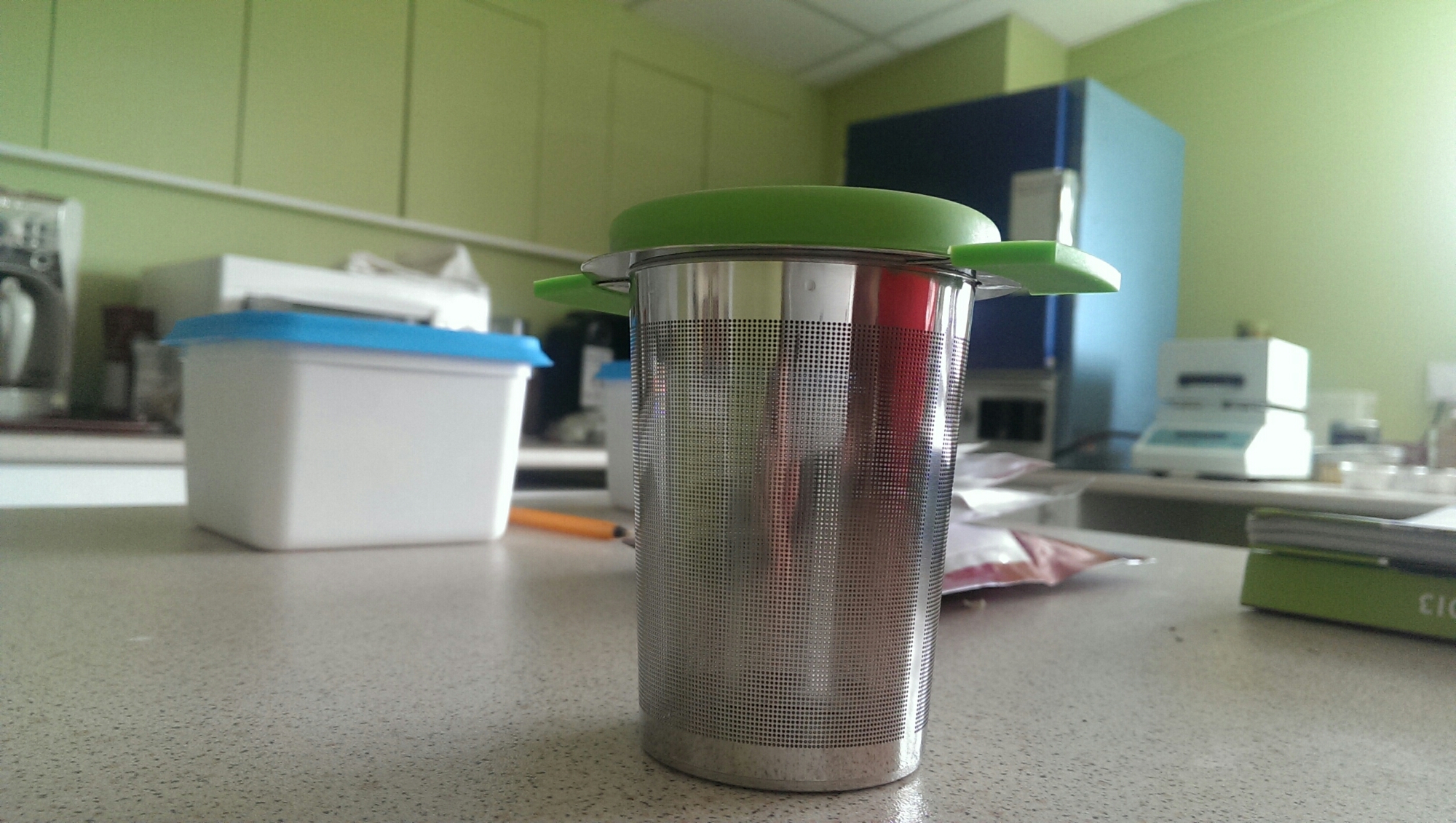
A particularly pleasurable feature of these teas is the distinctive floral aroma on the infusion (the wet leaves) best enjoyed by separating leaf from liquor using an infuser or better still try our professional tea tasting set [AC03] – sniffing the warm infusion from beneath the lid offers a galaxy of changing aromas.

Tea Talk – Withering

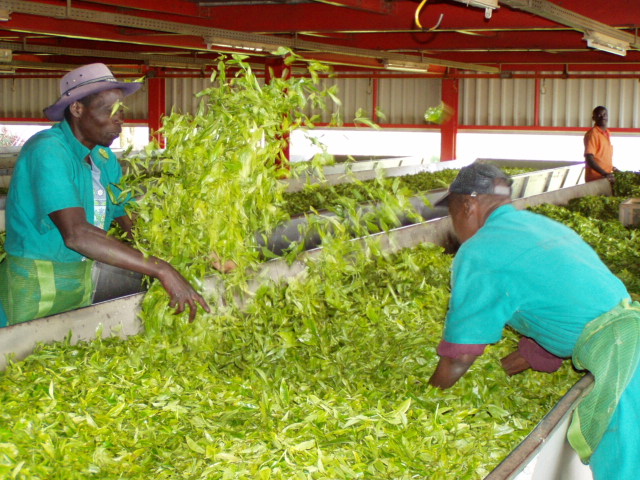
When plucked fresh in the field tea leaves are crisp and if rolled in the hand will break up into flakes. Rolling machinery in the tea factory needs a soft pliable material to form into the stylish curled and twisted shapes that are typical of premium teas. Withering, at least in the sense that a teaman uses the word, means gently losing moisture from the fresh leaf until the resulting withered leaf is limp and ready for the rolling stage. This means losing some 25 to 50% of the weight of the fresh leaf as evaporated water, and the process takes around 18 hours.

Before we consider exactly what happens in withering we should be clear which teas do and don’t need withering to develop their character.

Green Teas – no wither. Pliable leaf is achieved by steaming (Japanese green teas) or by parching – dry heating in a wok (China green teas)

All other teas require withering, but the style of this varies.

White Teas – very slow and gentle wither often initially in sunlight and then under shade, in thin layers, for up to three days.

Oolong Teas – also begin with 1 or 2 hours of sun withering, then into shade for 16 hours during which time the leaf is “fluffed” many times by hand to gently bruise it.

Black Teas – leaf for these used to be thinly spread on tats (banks of mesh trays) but now it receives 16 to 18 hours of drying on special troughs that allow warmed air to be blown through the bed of leaf until the correct moisture content is achieved.
leaf plucking
Fresh leaf photosynthesizes in sunlight and produces glucose. Further biosynthesis produces a range of compounds that are temporarily stored in the leaf cells as starch and proteins and fats. Loss of water during withering causes the leaf to mobilize its stored reserves converting them to sugars amino acids and lipids – all of which are essential for the development of aroma volatiles and flavours during the rolling and oxidation processes.

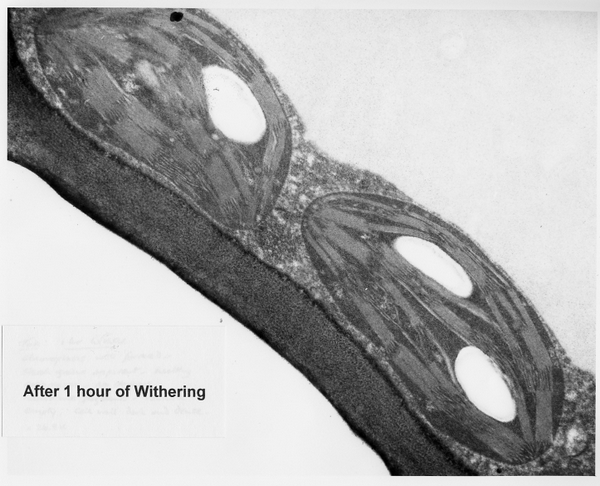
This electron microscope photograph of two chloroplasts in a tea leaf cell after 1 hour of withering clearly shows large white starch grains – stored carbohydrate which will be fully solubilized into sugar within 8 or 10 hours. There are about 200 tiny chloroplasts in each leaf cell and each one is a biochemical powerhouse.

cell1

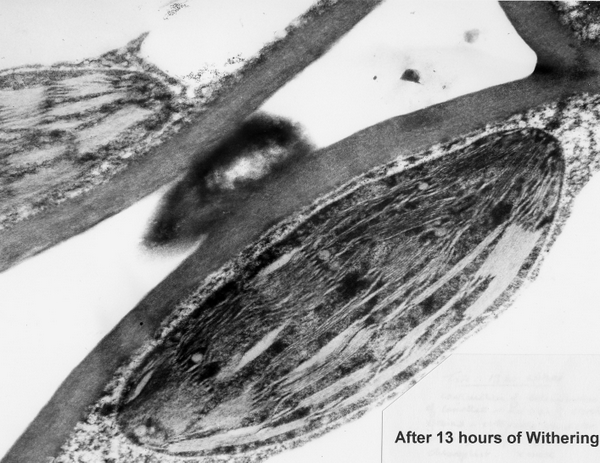
After 13 hours withering the chloroplast shows no starch grains but dark staining lipid globules can be seen as the leaf’s fat reserves are also solubilized.

cell2

At this stage the leaf is almost ready biochemically for oxidation, but withering usually continues to around 16-18 hours to ensure that the leaf is physically ready for rolling or cutting.

The amount of moisture lost from the leaf determines to a great extent the type of tea that will be produced:

Soft wither – little water loss – strong pungent and coloury black CTC teas of Assam and Africa

Medium wither – moderate water loss – orthodox black teas of Assam and Ceylon low country teas with more aroma than CTC teas

Hard wither – much water loss – Ceylon high grown teas with pronounced aroma and flavour

Very hard wither – extreme water loss to the point where some leaf is too dry to oxidize and remains green in the made tea – Darjeelings and Nepals with world famous aroma

Tea tasters can tell just by looking at and tasting the finished tea whether the withering process has been carried out correctly in the factory. Some of the clues to bad withering are:

Harsh metallic taste – wither too short, not enough moisture loss

Flakey leaf – if black and flakey then wither too short (too soft) and if green and flakey then wither too long or too hard

Acid fruity aroma and taste – often due to bacterial growth when rain wetted leaf is withered too slowly or not dried before withering

Plain tasting tea grey in the cup – over long or over hot wither

Tea Talk – Rolling

Nearly all black teas are pressure treated to initiate oxidation which requires the miniscule chloroplasts in the green leaf cells to be “popped” to release the enzyme polyphenoloxidase that catalyses the oxidation of green catechins to form orange theaflavins (which then polymerize into brown thearubigins) – to make a typical black tea. Popping the chloroplasts requires a lot of pressure – this was originally done manually and now, in Orthodox processing, the pressure is provided by a rolling table.

rolling 1

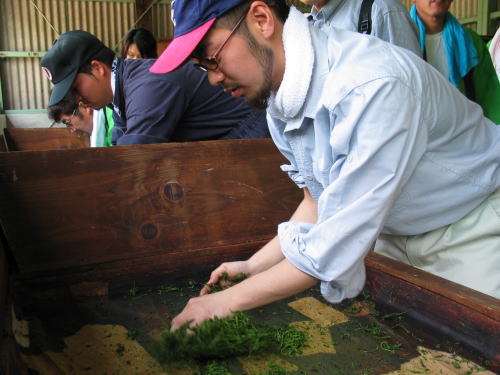
Traditionally in China green leaf was hand rolled between the palms of the hands rotating them anticlockwise ninety degrees out of sync. In Japan – see photograph to the right – green leaf was hand rolled backwards and forwards between the hands and a flat surface. Thus in China hand rolling gives a twist and curl to the leaf – ultimately giving the well known gunpowder pellet. The orthodox rolling table, particularly the double acting type, is based on this rotating hand action and is used both for green and black tea manufacture. In Japan the forwards-backwards hand motion produces cylindrical needles, and modern Japanese green tea machinery mimics this hand action and product format.

rolling2

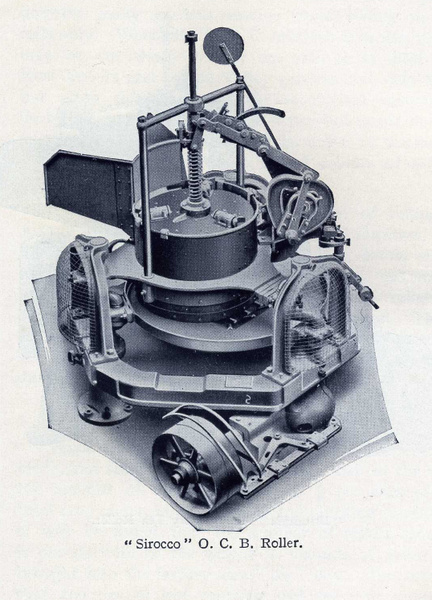
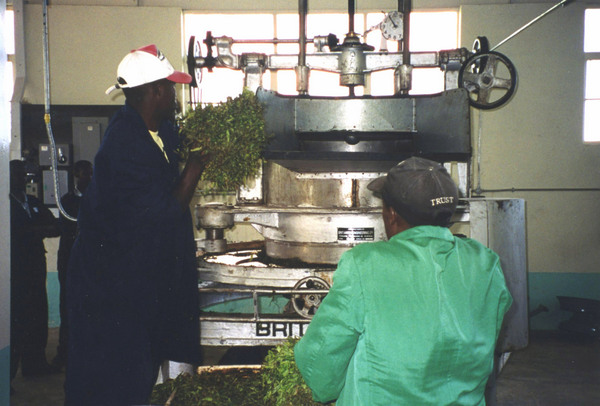
Rolling tables were first introduced by the British in the 1880’s as factory sizes grew, and to take advantage of developments in steam power and oil engines. The basic design has not changed to this day – a flat table some 2 metres across bearing an eccentrically rotating drum containing around 300 kg of withered leaf, and a pressure cap on the drum to squeeze the leaf – see photograph above of a British built Sirocco rolling table from the 1920’s: this would have been leather belt driven from overhead lay shafting probably powered by a central oil engine. It clearly shows the table, the drum and the pressure cap. Modern tables are very little different except that they are driven by electric motors – they are still hand loaded and – see photograph below of a new Indian built machine installed in Kenya in 2002 – and still called Britannia!

rolling3

Within the moving drum the leaf travels in a torroidal motion – imagine a doughnut ring with the leaf moving around the ring and also spirally from outer edge to inner and round again – this movement squeezes leaf hard against the table, the drum sides and the pressure cap in turn. Pressure is increased further in some rolling tables by putting crescent shaped battens on the table and a cone in the centre.

Typically a charge of leaf is rolled for 20-30 minutes and then sifted. Fine particles that fall through the sieves are collected for the next stage – Oxidation, while large unbroken leaf is returned to the rolling table for a further roll. In Sri Lanka it is not unusual for there to be four rolls in sequence, each under increasing pressure.

The rolling induced chloroplast popping action is helped by Withering (discussed in the May 2007 NBT Newsletter); withering weakens the cell membranes allowing the chloroplast to rupture with less pressure, thus black teas are withered, but green teas that do not require oxidation are not. The heavy rolling pressure required to induce oxidation – particularly with battens and cone as seen above – not only pops the chloroplasts but also breaks the shoot into pieces and curls and twists it giving character and style. The leaf pieces are ultimately sorted into the well known tea grades of commerce. Pekoe (P) may have some whole leaf but no tips. Orange Pekoe (OP) is primarily twisted stem, and no tips. Flowery Orange Pekoe (FOP) may have curled leaf pieces and some tip. Tippy grades come from the first sifting which removes the tender buds and tips; broken grades are smaller pieces derived primarily from the later rolls.

Tea Talk – Yerba Mate

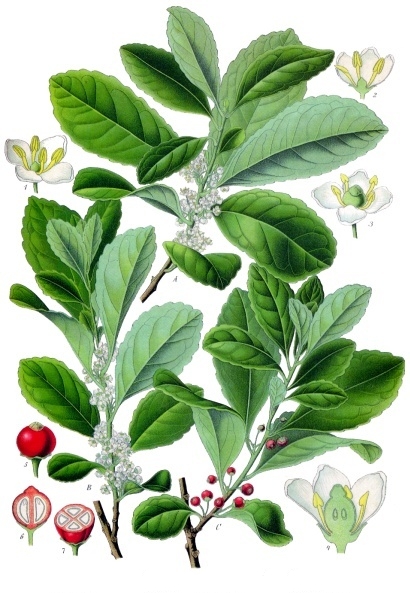
The natives of South America were drinking several caffeine containing beverages long before the Conquistadors came ashore. Chief of these was Mate, made from the leaves of a small evergreen tree, a species of Holly (Ilex paraguariensis) native to subtropical Argentina, eastern Paraguay, western Uruguay and southern Brazil. While maté is the common spelling in English and indicates the proper pronunciation, it should be remembered that in Spanish maté is the first person singular past tense of the verb matar = to kill, thus meaning [I] killed (!)

yerba mate

Huge amounts of mate are consumed in South America where communal mate drinking follows a traditional ritual just as complex as the Japanese Tea Ceremony; though modern pressures of life mean that city dwellers carry their mate with them to sip throughout the day, just as the Chinese do with their green tea.
Mate is infused by steeping the dry leaves (and twigs) in hot water, rather than in boiling water like black tea; as with green tea it is generally considered too bitter if steeped in water at boiling point. Traditionally, and when drinking with friends the infusion is made very strong in a hollow gourd – also called a mate in Spanish, thus Yerba mate literally means Gourd or Cup Herb. A metal straw (a bombilla) with a filter in the base is used to sip the infusion as the gourd is passed round the group. At frequent intervals the infusion is topped up with hot water by the appointed hostess. As well as in Argentina, Bolivia, Uruguay, Paraguay, South Brazil and parts of Chile you may find the mate ritual performed in Syria and Lebanon, both countries that import huge amounts of green mate leaf.
Much as with tea, one can purchase flavored mate in many varieties, and in Brazil green mate is toasted to produce a very popular milder beverage known as chá mate, sold in teabag and loose form, and served, sweetened, in specialized shops, either hot or iced with fruit juice or milk, and even as a soft drink. The toasted variety of mate has less of a bitter flavor and more of a spicy fragrance and is mostly consumed in the coastal cities of Brazil as opposed to the far southern states where green mate is preferred in the traditional way.

In Paraguay, green yerba mate is also drunk as a cold beverage. Usually drunk out of a cow’s horn in the countryside, tereré, as it is known in the Guaraní language, is served with cold or iced water. Medicinal herbs, known as “yuyos”, are mixed in a mortar and pestle and added to the water for flavouring or medicinal reasons.

Mate bushes are grown on plantations much as are tea bushes, very little is now collected from the wild. The plant is cultivated and processed mainly in northern Argentina, Paraguay, Uruguay and southern Brazil. World production is around 300,000 tonnes per annum, the largest exporter is Argentina, shipping around 60,000 tonnes to neighbouring countries and to the eastern Mediterranean. Mechanical harvesting is common and the 40 to 50 cm long branches are dried in a factory. Traditionally this was done over a wood fire, imparting a smoky flavor. When dried the leaves are stripped and twigs are broken up to form crude green mate which is stored for 12 months to mellow the taste. Before sale the crude raw material is sorted – there are many grades and types of yerba, with and without twigs, and with varying powder content – each type has its devotees. The sex of the mate bush can also determine strength of the leaf flavour, caffeine level and other nutrients, depending on whether it is a male or female plant. Female plants tend to be milder in flavour, and lower in caffeine, though on commercial plantations it is the male bush that is favoured for planting.

The caffeine content of mate is relatively low – from 0.3% to 1.9% of dry weight (compare this to 2.0–5.0% for tea leaves, and 2.0% for ground coffee). However, the custom of brewing mate very strong in the gourd and then progressively diluting the beverage as it is communally consumed makes actual caffeine intake difficult to estimate compared to a single cup of coffee or tea.

Yerba mate contains natural antioxidants and various studies are showing it to exhibit significant cancer-fighting activity. Researchers at the University of Illinois (2005) found yerba mate to be “rich in antioxidant phenolic constituents” and to “inhibit oral cancer cell proliferation”. Emerging research also shows that yerba mate preparations may be useful in treating heart disease.

In addition to the Green Mate, we also stock a range of flavoured Mates. Moroccan Mate, Magic Mate, Sweet Mate, Sunrise and the Punchy Devils Mate.