The Knighting of Sir Thomas
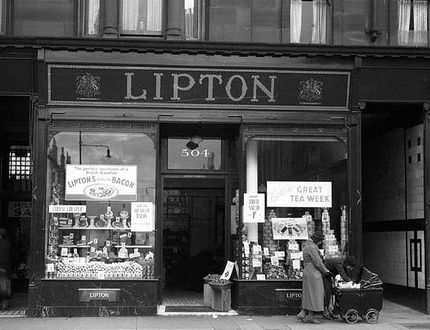
By 1895 the boy from the Glasgow slums had achieved much. Now aged 46 he was already a millionaire, lived on a sixty acre estate well beyond the north London suburbs, had opened his extensive London offices in City Road, had a chain of grocery shops across Britain, had businesses and properties in America, and owned tea and rubber estates in Ceylon. But while his Lipton shops and his advertising stunts were often the subject of news reports and leaders in the provincial press not one mention can be found of Thomas Lipton the man in the archives of “The Times”- not that is until 1896. This was to be a pivotal year for Lipton, the society shunning businessman who often claimed “I advertise my business, not myself.”
Ten years earlier Tommy in one of his typical advertising stunts had offered Queen Victoria a five ton cheese – “the most marvellous product of dairy enterprise of all ages” – to celebrate Her Majesty’s Golden Jubilee. Doubtless he was not surprised to find his offer “Respectfully declined” on the grounds that the Queen could not accept presents from private individuals to whom she was not personally known. Many newspapers criticised his offer and rejoiced in the perceived snub, though Lipton relished the publicity that once again attracted even more customers to his stores. Who then would have guessed that before the century closed Tommy Lipton would kneel at the Queen’s feet and arise as Sir Thomas?
Some claim that Lipton’s debut into the limelight was in 1895 when he received the Royal Warrant to supply Queen Victoria with tea. But that still was recognition of Lipton tea rather than Lipton the man. How much his elevation into English high society was a happy accident or a shrewd business plan can only now be guessed at. But for certain the branding of Thomas Lipton required exactly the same consummate marketing skills that built his business.
The story begins in April 1896. Lipton was fresh back from a trip to his beloved estates in Ceylon and read in The Times an open letter from Princess Alexandra, the Princess of Wales, to the Lord Mayor of London. In this letter she pleaded for commemoration of the Queen’s Diamond Jubilee not by the erection of yet another statue but by helping “the poorest of the poor in the slums of London” suggesting “let us provide these unfortunate ones, these poor beggars and outcasts with a substantial meal during the week of the Jubilee celebrations” and as well as encouraging the Lord Mayor to do this in all parts of London, she sent her personal cheque for £100.
Thomas Lipton shunned society but was not reclusive; he spent no money on himself but poured it avidly into his business that was both his hobby and his life. He had a generous nature, particularly when giving involved receiving some publicity. As he had done many times before to such appeals he offered all the tea and sugar that the Princess Alexandra Appeal could use – and he noted with satisfaction the public response to his generosity. Later, on being thanked by Sir George Faudel Phillips, the Lord Mayor, Lipton enquired how the fund was going and learned that of the £30,000 required only a fraction had been received. Just as now public charity then was subject to “disaster fatigue” and appeals had recently been raised for Welsh miners, for the Indian famine, and for wounded Greeks: as a result the Princess’s shilling fund organised in the Daily Telegraph was not doing well. On hearing this Thomas Lipton made a decision that was to change his life – he took up his pen and wrote a cheque for £25,000 (equivalent to two million pounds today) – handing it to the Lord Mayor on the sole condition that it be an anonymous donation. Tommy Lipton had great sympathy with the poor, he had been raised in a slum, and had clawed his way out; his pity acknowledged that he could still be trapped there.
Lipton also knew full well the way the press would respond to news of a last minute anonymous benefactor: the public curiosity, the speculation, the feverish hunt to put a name to the deed. The press responded as he expected and, as he had already donated in kind and had no reputation for giving out cash, speculated excitedly and inaccurately about the unknown donor. After ten days when the hunt was at its height Lipton allowed the Lord Mayor to release his name – and the press reacted with even greater vigour. Here was a story indeed! When interviewed Tommy responded with tales of his early life and struggle to build his business, and his stunts: elephants hauling tea from the docks, the gold sovereigns in the monster cheeses, the orphan pigs and the fake bank notes promising the bearer good bacon, ham and cheese at Lipton’s shops. Very soon he was supervising the organisation of the Fund’s dinners for 400,000 persons – to each a one pound meat pie, a two pound loaf, four ounces of cheese and half a pound of cake, ginger beer and lemonade and of course Lipton tea. Just to deliver the 700,000 kilograms of food parcels to halls around London took four hundred removal vans. The Dinner was hailed an outstanding success. ‘Jubilee Lipton’ as he was dubbed was again interviewed by an avid press, and revealed that he was engaged on an even larger scheme – the Alexandra Trust – to alleviate poverty by supplying cheap wholesome food to the poor. Lipton had already contributed a further £100,000 to this new work and was now unquestionably, just three short months after his return from Ceylon and without effort, a major celebrity. More curious still, while having shown no discernable previous interest in royalty, he had earned the deep and sincere gratitude of the wife of the future King of England.
Queen Victoria’s New Year’s Honours List of 1897 included Her Majesty’s solicitor, two of Her Majesty’s doctors, three of Her Majesty’s colonial officials – and at the personal request of Princess Alexandra, Her Majesty’s grocer. The press cooed congratulations. Vanity Fair – a Victorian version of OK Magazine – observed that he was “an excellent amiable fellow and trade was properly honoured in him”.
Yes, life had certainly taken a new turn for Sir Thomas Lipton – but would celebrity fame turn his head?
Next Part -how Sir Thomas the grocer captivated London’s diamond studded high society, and launched a flotilla of racing yachts.
Excellent – informative read – thank you.