Monthly Archives: January 2014

Tea Heroes – Sir Thomas Lipton Part Four

The Knighting of Sir Thomas
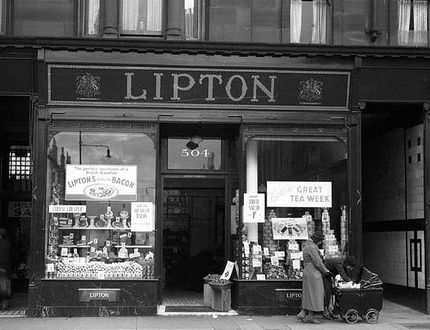
Lipton shopfront 1

By 1895 the boy from the Glasgow slums had achieved much. Now aged 46 he was already a millionaire, lived on a sixty acre estate well beyond the north London suburbs, had opened his extensive London offices in City Road, had a chain of grocery shops across Britain, had businesses and properties in America, and owned tea and rubber estates in Ceylon. But while his Lipton shops and his advertising stunts were often the subject of news reports and leaders in the provincial press not one mention can be found of Thomas Lipton the man in the archives of “The Times”- not that is until 1896. This was to be a pivotal year for Lipton, the society shunning businessman who often claimed “I advertise my business, not myself.”

Ten years earlier Tommy in one of his typical advertising stunts had offered Queen Victoria a five ton cheese – “the most marvellous product of dairy enterprise of all ages” – to celebrate Her Majesty’s Golden Jubilee. Doubtless he was not surprised to find his offer “Respectfully declined” on the grounds that the Queen could not accept presents from private individuals to whom she was not personally known. Many newspapers criticised his offer and rejoiced in the perceived snub, though Lipton relished the publicity that once again attracted even more customers to his stores. Who then would have guessed that before the century closed Tommy Lipton would kneel at the Queen’s feet and arise as Sir Thomas?

Some claim that Lipton’s debut into the limelight was in 1895 when he received the Royal Warrant to supply Queen Victoria with tea. But that still was recognition of Lipton tea rather than Lipton the man. How much his elevation into English high society was a happy accident or a shrewd business plan can only now be guessed at. But for certain the branding of Thomas Lipton required exactly the same consummate marketing skills that built his business.

The story begins in April 1896. Lipton was fresh back from a trip to his beloved estates in Ceylon and read in The Times an open letter from Princess Alexandra, the Princess of Wales, to the Lord Mayor of London. In this letter she pleaded for commemoration of the Queen’s Diamond Jubilee not by the erection of yet another statue but by helping “the poorest of the poor in the slums of London” suggesting “let us provide these unfortunate ones, these poor beggars and outcasts with a substantial meal during the week of the Jubilee celebrations” and as well as encouraging the Lord Mayor to do this in all parts of London, she sent her personal cheque for £100.

Thomas Lipton shunned society but was not reclusive; he spent no money on himself but poured it avidly into his business that was both his hobby and his life. He had a generous nature, particularly when giving involved receiving some publicity. As he had done many times before to such appeals he offered all the tea and sugar that the Princess Alexandra Appeal could use – and he noted with satisfaction the public response to his generosity. Later, on being thanked by Sir George Faudel Phillips, the Lord Mayor, Lipton enquired how the fund was going and learned that of the £30,000 required only a fraction had been received. Just as now public charity then was subject to “disaster fatigue” and appeals had recently been raised for Welsh miners, for the Indian famine, and for wounded Greeks: as a result the Princess’s shilling fund organised in the Daily Telegraph was not doing well. On hearing this Thomas Lipton made a decision that was to change his life – he took up his pen and wrote a cheque for £25,000 (equivalent to two million pounds today) – handing it to the Lord Mayor on the sole condition that it be an anonymous donation. Tommy Lipton had great sympathy with the poor, he had been raised in a slum, and had clawed his way out; his pity acknowledged that he could still be trapped there.

Lipton also knew full well the way the press would respond to news of a last minute anonymous benefactor: the public curiosity, the speculation, the feverish hunt to put a name to the deed. The press responded as he expected and, as he had already donated in kind and had no reputation for giving out cash, speculated excitedly and inaccurately about the unknown donor. After ten days when the hunt was at its height Lipton allowed the Lord Mayor to release his name – and the press reacted with even greater vigour. Here was a story indeed! When interviewed Tommy responded with tales of his early life and struggle to build his business, and his stunts: elephants hauling tea from the docks, the gold sovereigns in the monster cheeses, the orphan pigs and the fake bank notes promising the bearer good bacon, ham and cheese at Lipton’s shops. Very soon he was supervising the organisation of the Fund’s dinners for 400,000 persons – to each a one pound meat pie, a two pound loaf, four ounces of cheese and half a pound of cake, ginger beer and lemonade and of course Lipton tea. Just to deliver the 700,000 kilograms of food parcels to halls around London took four hundred removal vans. The Dinner was hailed an outstanding success. ‘Jubilee Lipton’ as he was dubbed was again interviewed by an avid press, and revealed that he was engaged on an even larger scheme – the Alexandra Trust – to alleviate poverty by supplying cheap wholesome food to the poor. Lipton had already contributed a further £100,000 to this new work and was now unquestionably, just three short months after his return from Ceylon and without effort, a major celebrity. More curious still, while having shown no discernable previous interest in royalty, he had earned the deep and sincere gratitude of the wife of the future King of England.

Queen Victoria’s New Year’s Honours List of 1897 included Her Majesty’s solicitor, two of Her Majesty’s doctors, three of Her Majesty’s colonial officials – and at the personal request of Princess Alexandra, Her Majesty’s grocer. The press cooed congratulations. Vanity Fair – a Victorian version of OK Magazine – observed that he was “an excellent amiable fellow and trade was properly honoured in him”.

Yes, life had certainly taken a new turn for Sir Thomas Lipton – but would celebrity fame turn his head?

Next Part -how Sir Thomas the grocer captivated London’s diamond studded high society, and launched a flotilla of racing yachts.
Tea Hero – Sir Thomas Lipton Part Three

In the second part of Tommy Lipton’s story we saw him grow his grocery empire countrywide using hard work and the circus derived promotional skills he had learned in America from Barnum & Bailey. We left him taking a rare holiday after the death of his beloved mother and within six months his father; taking a sea trip to Australia, stopping off in Ceylon with £75,000 in his pocket looking for new business opportunities.

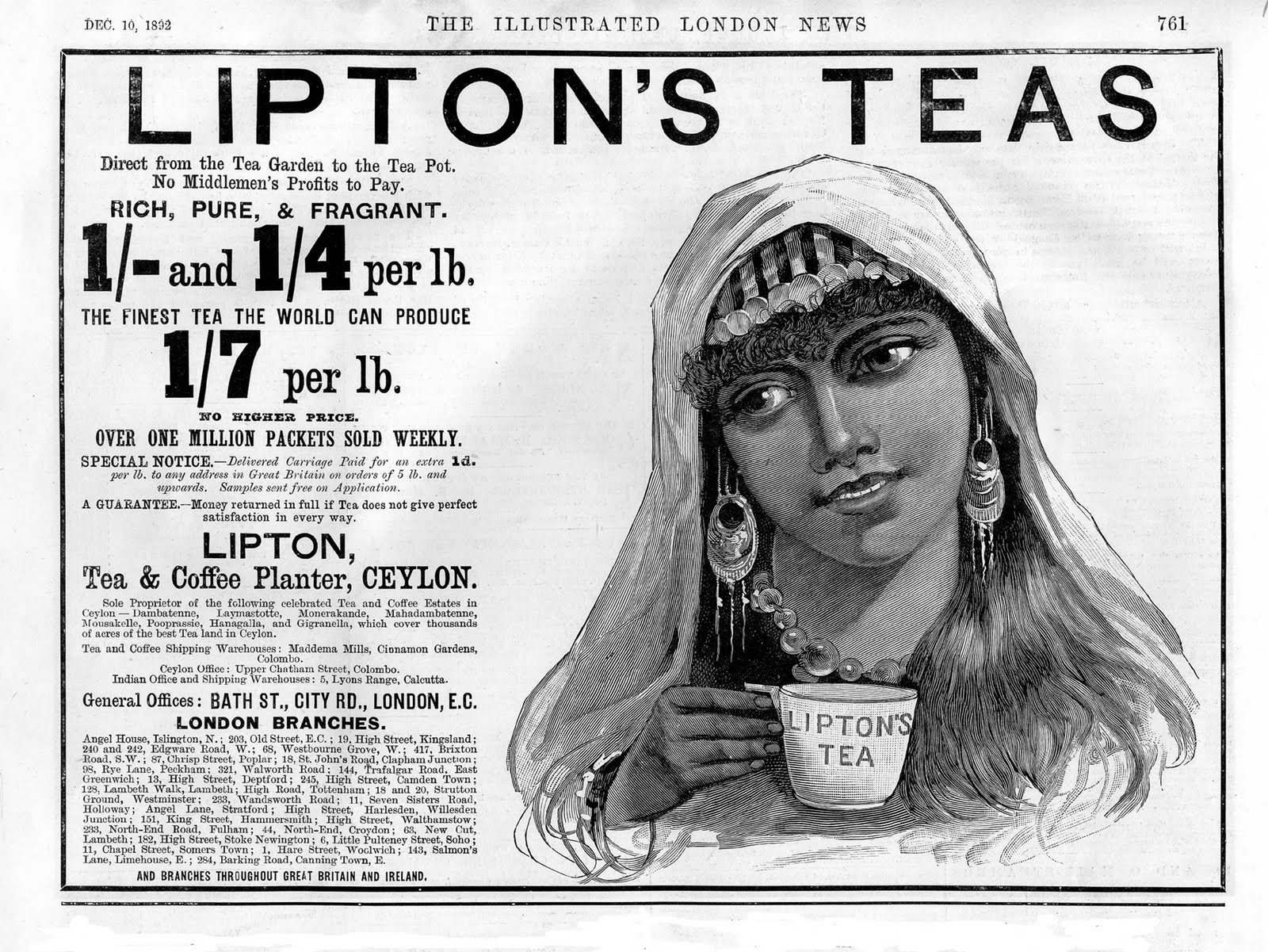
Lipton Press Advert

To understand why Lipton invested in buying three tea estates during that short stopover we need to look at how tea was retailed in the 1880s. Tommy was a typical grocer selling a range of fresh and preserved provisions: bacon, ham, eggs, butter and cheese, sugar, jams, meat pastes, coffee and tea. In those days a general grocer had a couple of open chests of tea on display and weighed and packed tea to order in folded ‘sugar paper’ packets made up by the shop boy in any spare time left after sweeping up and delivering orders. Higher class grocers would offer customers a house blend of an English Breakfast style, and perhaps a green tea also. Customers wanting a wider selection of teas would frequent a specialist tea merchant such as Twinings. Lipton had always purchased his tea as he did his sugar, in bulk from an importer. His sourcing of tea direct from his own Ceylon gardens allowed him to create a distinct brand and coin his immortal slogan – that “Lipton cuts out the middleman”. This move into producing his own raw material was to change his company, his life, and certainly the history of tea.

Retail packaging of tea, first introduced by Horniman’s Tea Company in the 1860’s to avoid contamination was still in its infancy – but Tommy Lipton was about to popularise it until the extra price the customer paid for packaging would be willingly accepted as a guarantee of quality and consistency.

When in 1890 Lipton disembarked into the moist tropical heat of Colombo to meet his agent Frank Duplock, who had travelled ahead prospecting for opportunities, he set foot in a country whose agriculture was in turmoil. Ceylon had been the Colonial coffee producer, Assam was the tea producer; but from the mid-1870s a fungal blight rapidly destroyed the island’s coffee production and land prices plummeted. Coffee rust (Hemileia vastatrix) wryly nicknamed ‘Devastating Emily’ had no known cure and the ruined planters in desperation turned to tea. This move proved a life saver and by 1890, when Lipton arrived, tea production had already leaped to a quarter of Assam’s annual exports. At the Grand Oriental Hotel, then Colombo’s only hotel, when Lipton asked Duplock about the business prospects; Frank replied “They are pretty good, sir.” Lipton replied, “Then I’ll break my journey”.

Buying his first tea estates was a typical Tommy Lipton snap decision. Hearing of three estates on offer he travelled up country by the train, winding through vast copra plantations, then rubber, through the abandoned coffee estates, and hauling up 6,000 feet to lush tea gardens. Three estates were on offer and Dambatene was the first he inspected. Anyone visiting this estate today will understand how he felt: green velvet fields overlooking a valley falling a sheer 4,000 feet, with the coast visible 60 miles away. Within hours Lipton had cabled his offer to the London based owners (at half the asking price and leaving Lipton with £50,000 of his investment fund untouched) and within a day had become the sole proprietor of his own tea empire.

Lipton never blended tea in the sense that Tetley or PG Tips now do – a mix of perhaps 30 different tea origins carefully selected to maintain a brand profile, to minimise cost and to maximise profit. While the Lipton blend did contain some Indian tea Tommy’s Lipton brand retained the Ceylon character and only Ceylon was mentioned in his advertising. As we have seen Lipton was a consummate salesman, he worked by emphasising the key attributes of his tea – briskness and aroma; by inventing a novel description – Orange Pekoe – that still confuses consumers; and sold his tea so fast that it ensured freshness “Direct from the Tea Gardens to the Teapot”. His branded tea stood out from the heavy Assams and the often stale and plain China’s. Tommy differentiated his product from the competition and sold it on its benefits. Supported by intensive (and often very creative) advertising and massive promotion Lipton had invented FMCG – Fast Moving Consumer Goods – without which concept our modern supermarkets would not exist.

Thomas Lipton’s three tea estates quickly became five, then eight. To supplement his own production he was soon buying tea on the Colombo Auction. His 300 groceries could not keep up with demand for the yellow and red labelled quarter and half pound packs of Orange Pekoe. A quality product at a reasonable price (1/-, 1/4 and 1/7 per lb) with “No Middlemen’s Profits to Pay” created consumer demand. Lipton’s advertising skills fanned demand into clamour and the hoardings and press adverts were soon claiming “Over one million packets sold weekly”. On signing a cheque for £35,000 for tea import duty in a week when the Chancellor of the Exchequer had announced an increase on income tax, instead of complaining about the ever increasing tax bill he paid, Lipton boasted to the press how he would soon be signing six figure cheques “Why all this fuss about an additional penny on income tax? Let good patriots drink more Lipton’s tea so that the cheques for duty may increase till personal taxation is abolished.”

When Lipton first saw Dambatene he was already a millionaire. His venture into tea increased his wealth many times, but it was all returned to building his business, increasing its size and influence. Apart from moving his home to London and commercial headquarters to City Road, Tommy Lipton’s personal life at 46 was very little different to 20 years before. Lipton the brand was on everyone’s lips but Lipton the man was virtually unknown. He was in fact a very private man with few friends and no interest in politics, literature or the theatre; the bawdy Naughty Nineties of Wilde and Beardsley were not to Lipton’s taste. He was never “seen about town” nor talked about in society. However, with the change of the century there was to be a profound change in Lipton’s social position, and that was perhaps his greatest branding masterpiece.

Next Part – how plain Tommy Lipton the grocer became Sir Thomas Lipton, Knight of the British Empire