Monthly Archives: July 2013

White Tea

White tea is the least processed of all teas. White teas may be made from just the buds (needles) or from the topmost young leaf. Fine white hairs cover the loosely rolled leaves that may be dark green or even black. The true ‘white’ character is seen in the liquor- clear and almost colourless with a delightful sweet and mellow taste-but this tea is sensitive so never use water hotter than 70C to brew your white tea. Caffeine content is naturally low, and antioxidants are abundant, sometimes as much as three times the level of regular teas.

White tea is the rarest type of tea because of its limited availability. What separates white tea from black, green and oolong is the way it is made – carefully selected plants plucked gently at dawn with the dew fresh on the leaf, and manufactured by hand with natural wither and drying using sunlight.

Like green tea, White tea is unfermented but fermentation is avoided by gentle handling rather than by steaming or roasting. Initial drying is done in the morning sun, followed by gentle hand rolling to give some curl to the leaf but not hard enough to break the cells and cause fermentation. The leaf is then dried completely in the strong afternoon sun. White tea is rare and expensive because of the skilled hand making involved, and because conditions are only right for making it at certain parts of the year.

More Tea is always seeking new and unusual sources for tea. While white tea has traditional been from China, we have stocked small quantities of white tea from many other sources over the years. Malawi, Zimbabwe, Turkey, Sri Lanka, where they are made in very small quantities.

Tea Talk – Withering

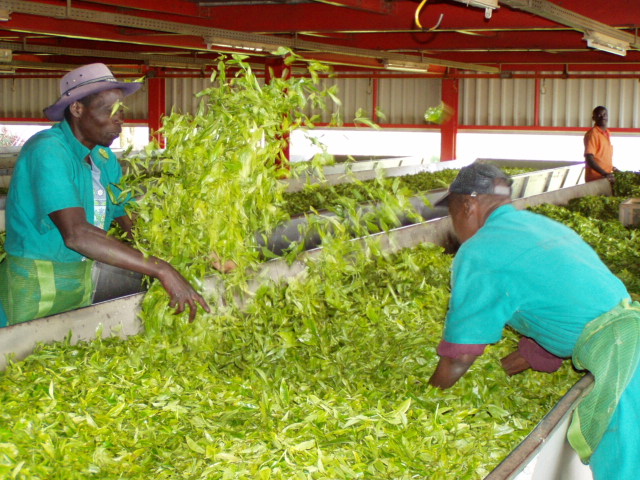
When plucked fresh in the field tea leaves are crisp and if rolled in the hand will break up into flakes. Rolling machinery in the tea factory needs a soft pliable material to form into the stylish curled and twisted shapes that are typical of premium teas. Withering, at least in the sense that a teaman uses the word, means gently losing moisture from the fresh leaf until the resulting withered leaf is limp and ready for the rolling stage. This means losing some 25 to 50% of the weight of the fresh leaf as evaporated water, and the process takes around 18 hours.

Before we consider exactly what happens in withering we should be clear which teas do and don’t need withering to develop their character.

Green Teas – no wither. Pliable leaf is achieved by steaming (Japanese green teas) or by parching – dry heating in a wok (China green teas)

All other teas require withering, but the style of this varies.

White Teas – very slow and gentle wither often initially in sunlight and then under shade, in thin layers, for up to three days.

Oolong Teas – also begin with 1 or 2 hours of sun withering, then into shade for 16 hours during which time the leaf is “fluffed” many times by hand to gently bruise it.

Black Teas – leaf for these used to be thinly spread on tats (banks of mesh trays) but now it receives 16 to 18 hours of drying on special troughs that allow warmed air to be blown through the bed of leaf until the correct moisture content is achieved.
leaf plucking
Fresh leaf photosynthesizes in sunlight and produces glucose. Further biosynthesis produces a range of compounds that are temporarily stored in the leaf cells as starch and proteins and fats. Loss of water during withering causes the leaf to mobilize its stored reserves converting them to sugars amino acids and lipids – all of which are essential for the development of aroma volatiles and flavours during the rolling and oxidation processes.

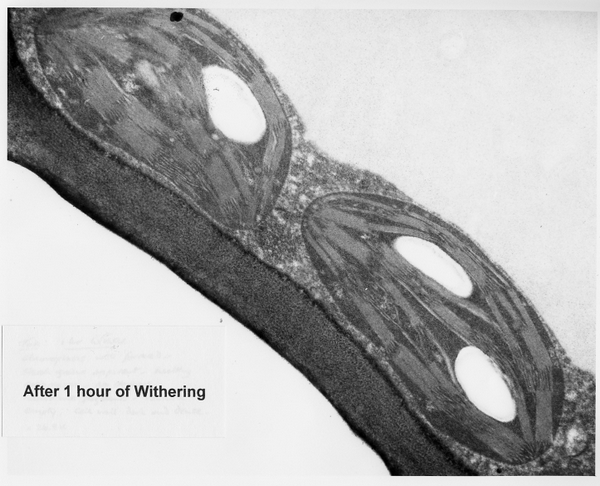
This electron microscope photograph of two chloroplasts in a tea leaf cell after 1 hour of withering clearly shows large white starch grains – stored carbohydrate which will be fully solubilized into sugar within 8 or 10 hours. There are about 200 tiny chloroplasts in each leaf cell and each one is a biochemical powerhouse.

cell1

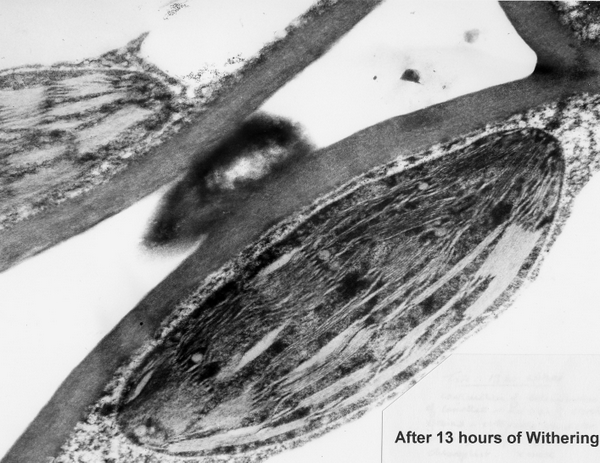
After 13 hours withering the chloroplast shows no starch grains but dark staining lipid globules can be seen as the leaf’s fat reserves are also solubilized.

cell2

At this stage the leaf is almost ready biochemically for oxidation, but withering usually continues to around 16-18 hours to ensure that the leaf is physically ready for rolling or cutting.

The amount of moisture lost from the leaf determines to a great extent the type of tea that will be produced:

Soft wither – little water loss – strong pungent and coloury black CTC teas of Assam and Africa

Medium wither – moderate water loss – orthodox black teas of Assam and Ceylon low country teas with more aroma than CTC teas

Hard wither – much water loss – Ceylon high grown teas with pronounced aroma and flavour

Very hard wither – extreme water loss to the point where some leaf is too dry to oxidize and remains green in the made tea – Darjeelings and Nepals with world famous aroma

Tea tasters can tell just by looking at and tasting the finished tea whether the withering process has been carried out correctly in the factory. Some of the clues to bad withering are:

Harsh metallic taste – wither too short, not enough moisture loss

Flakey leaf – if black and flakey then wither too short (too soft) and if green and flakey then wither too long or too hard

Acid fruity aroma and taste – often due to bacterial growth when rain wetted leaf is withered too slowly or not dried before withering

Plain tasting tea grey in the cup – over long or over hot wither

Tea Talk – Rolling

Nearly all black teas are pressure treated to initiate oxidation which requires the miniscule chloroplasts in the green leaf cells to be “popped” to release the enzyme polyphenoloxidase that catalyses the oxidation of green catechins to form orange theaflavins (which then polymerize into brown thearubigins) – to make a typical black tea. Popping the chloroplasts requires a lot of pressure – this was originally done manually and now, in Orthodox processing, the pressure is provided by a rolling table.

rolling 1

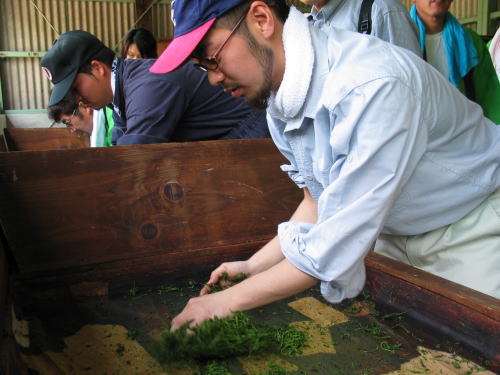
Traditionally in China green leaf was hand rolled between the palms of the hands rotating them anticlockwise ninety degrees out of sync. In Japan – see photograph to the right – green leaf was hand rolled backwards and forwards between the hands and a flat surface. Thus in China hand rolling gives a twist and curl to the leaf – ultimately giving the well known gunpowder pellet. The orthodox rolling table, particularly the double acting type, is based on this rotating hand action and is used both for green and black tea manufacture. In Japan the forwards-backwards hand motion produces cylindrical needles, and modern Japanese green tea machinery mimics this hand action and product format.

rolling2

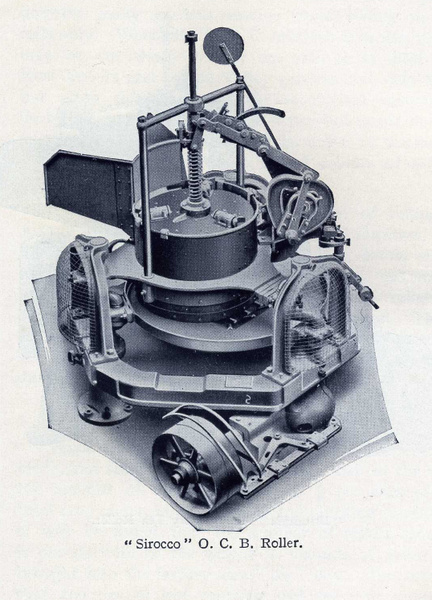
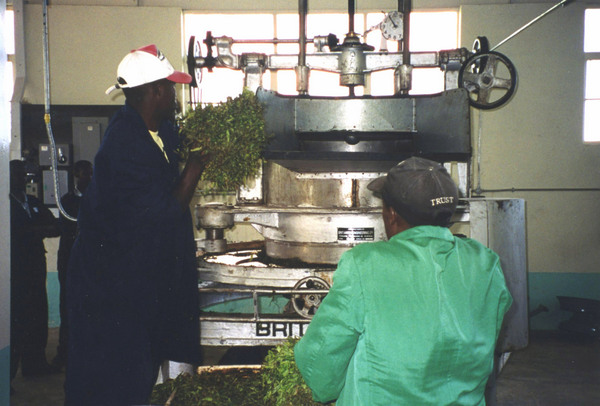
Rolling tables were first introduced by the British in the 1880’s as factory sizes grew, and to take advantage of developments in steam power and oil engines. The basic design has not changed to this day – a flat table some 2 metres across bearing an eccentrically rotating drum containing around 300 kg of withered leaf, and a pressure cap on the drum to squeeze the leaf – see photograph above of a British built Sirocco rolling table from the 1920’s: this would have been leather belt driven from overhead lay shafting probably powered by a central oil engine. It clearly shows the table, the drum and the pressure cap. Modern tables are very little different except that they are driven by electric motors – they are still hand loaded and – see photograph below of a new Indian built machine installed in Kenya in 2002 – and still called Britannia!

rolling3

Within the moving drum the leaf travels in a torroidal motion – imagine a doughnut ring with the leaf moving around the ring and also spirally from outer edge to inner and round again – this movement squeezes leaf hard against the table, the drum sides and the pressure cap in turn. Pressure is increased further in some rolling tables by putting crescent shaped battens on the table and a cone in the centre.

Typically a charge of leaf is rolled for 20-30 minutes and then sifted. Fine particles that fall through the sieves are collected for the next stage – Oxidation, while large unbroken leaf is returned to the rolling table for a further roll. In Sri Lanka it is not unusual for there to be four rolls in sequence, each under increasing pressure.

The rolling induced chloroplast popping action is helped by Withering (discussed in the May 2007 NBT Newsletter); withering weakens the cell membranes allowing the chloroplast to rupture with less pressure, thus black teas are withered, but green teas that do not require oxidation are not. The heavy rolling pressure required to induce oxidation – particularly with battens and cone as seen above – not only pops the chloroplasts but also breaks the shoot into pieces and curls and twists it giving character and style. The leaf pieces are ultimately sorted into the well known tea grades of commerce. Pekoe (P) may have some whole leaf but no tips. Orange Pekoe (OP) is primarily twisted stem, and no tips. Flowery Orange Pekoe (FOP) may have curled leaf pieces and some tip. Tippy grades come from the first sifting which removes the tender buds and tips; broken grades are smaller pieces derived primarily from the later rolls.

Tea Talk – Yerba Mate

The natives of South America were drinking several caffeine containing beverages long before the Conquistadors came ashore. Chief of these was Mate, made from the leaves of a small evergreen tree, a species of Holly (Ilex paraguariensis) native to subtropical Argentina, eastern Paraguay, western Uruguay and southern Brazil. While maté is the common spelling in English and indicates the proper pronunciation, it should be remembered that in Spanish maté is the first person singular past tense of the verb matar = to kill, thus meaning [I] killed (!)
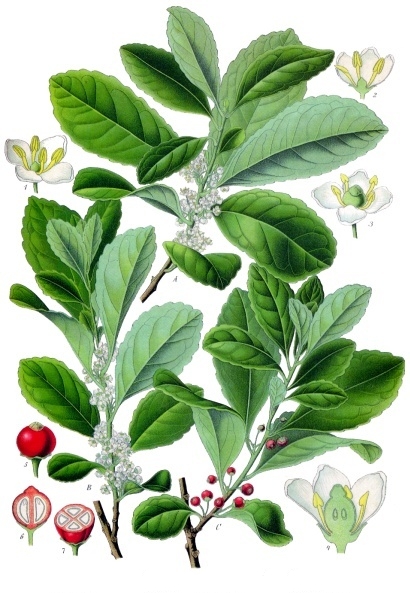
yerba mate

Huge amounts of mate are consumed in South America where communal mate drinking follows a traditional ritual just as complex as the Japanese Tea Ceremony; though modern pressures of life mean that city dwellers carry their mate with them to sip throughout the day, just as the Chinese do with their green tea.
Mate is infused by steeping the dry leaves (and twigs) in hot water, rather than in boiling water like black tea; as with green tea it is generally considered too bitter if steeped in water at boiling point. Traditionally, and when drinking with friends the infusion is made very strong in a hollow gourd – also called a mate in Spanish, thus Yerba mate literally means Gourd or Cup Herb. A metal straw (a bombilla) with a filter in the base is used to sip the infusion as the gourd is passed round the group. At frequent intervals the infusion is topped up with hot water by the appointed hostess. As well as in Argentina, Bolivia, Uruguay, Paraguay, South Brazil and parts of Chile you may find the mate ritual performed in Syria and Lebanon, both countries that import huge amounts of green mate leaf.
Much as with tea, one can purchase flavored mate in many varieties, and in Brazil green mate is toasted to produce a very popular milder beverage known as chá mate, sold in teabag and loose form, and served, sweetened, in specialized shops, either hot or iced with fruit juice or milk, and even as a soft drink. The toasted variety of mate has less of a bitter flavor and more of a spicy fragrance and is mostly consumed in the coastal cities of Brazil as opposed to the far southern states where green mate is preferred in the traditional way.

In Paraguay, green yerba mate is also drunk as a cold beverage. Usually drunk out of a cow’s horn in the countryside, tereré, as it is known in the Guaraní language, is served with cold or iced water. Medicinal herbs, known as “yuyos”, are mixed in a mortar and pestle and added to the water for flavouring or medicinal reasons.

Mate bushes are grown on plantations much as are tea bushes, very little is now collected from the wild. The plant is cultivated and processed mainly in northern Argentina, Paraguay, Uruguay and southern Brazil. World production is around 300,000 tonnes per annum, the largest exporter is Argentina, shipping around 60,000 tonnes to neighbouring countries and to the eastern Mediterranean. Mechanical harvesting is common and the 40 to 50 cm long branches are dried in a factory. Traditionally this was done over a wood fire, imparting a smoky flavor. When dried the leaves are stripped and twigs are broken up to form crude green mate which is stored for 12 months to mellow the taste. Before sale the crude raw material is sorted – there are many grades and types of yerba, with and without twigs, and with varying powder content – each type has its devotees. The sex of the mate bush can also determine strength of the leaf flavour, caffeine level and other nutrients, depending on whether it is a male or female plant. Female plants tend to be milder in flavour, and lower in caffeine, though on commercial plantations it is the male bush that is favoured for planting.

The caffeine content of mate is relatively low – from 0.3% to 1.9% of dry weight (compare this to 2.0–5.0% for tea leaves, and 2.0% for ground coffee). However, the custom of brewing mate very strong in the gourd and then progressively diluting the beverage as it is communally consumed makes actual caffeine intake difficult to estimate compared to a single cup of coffee or tea.

Yerba mate contains natural antioxidants and various studies are showing it to exhibit significant cancer-fighting activity. Researchers at the University of Illinois (2005) found yerba mate to be “rich in antioxidant phenolic constituents” and to “inhibit oral cancer cell proliferation”. Emerging research also shows that yerba mate preparations may be useful in treating heart disease.

In addition to the Green Mate, we also stock a range of flavoured Mates. Moroccan Mate, Magic Mate, Sweet Mate, Sunrise and the Punchy Devils Mate.