Tag Archives: tea hero

Tea Heroes – Sir Thomas Lipton Part Seven

Part 7. The end of the road for Sir Thomas, but not for Lipton

In our last Newsletter, we left Sir Thomas busily contributing to the war effort and Shamrock IV, built in 1914, safe in her wartime berth in Brooklyn. The Lipton Company prospered during the war as Sir Thomas maintained his usual high public profile, tirelessly campaigning and fund raising around the country for the Tank Bank, which built thousands of the new-fangled machines that helped shorten hostilities. Despite wartime food rationing, Lipton managed to return dividends to shareholders at pre-war levels.

Lipton fully intended to continue his quest for the America’s Cup. He joked with reporters that he “had to drink his tea from a saucer” as he was unable “to lift the cup”. In 1920, the first race of the post war series lined the snub-nosed, green-hulled Shamrock IV against the American yacht Resolute. Tens of thousands of spectators took to the water to watch the race amidst a media circus; reporters chased the yachts in a US Navy airship, and events were transmitted across the Atlantic within minutes by “wire-photo” – an early form of fax. The rules required that Resolute be allowed a seven minute start on Shamrock IV due to the latter’s larger sail area. Nevertheless, Shamrock won the race, mainly due to Resolute breaking a mainsail halyard. Characteristically, Sir Thomas refused to celebrate a victory based on an accident. But to wild acclaim, even from Americans, Lipton also won the second race, finishing nine minutes ahead, or twominutes with the handicap. To take home the Cup however, Shamrock IV needed a third win – and in this race, though pipping Resolute by half a minute, the result went to Resolute on the handicap, as did the fourth race. With a decider to sail for, the fifth race was postponed by the judges due to rough weather – which Shamrock IV was built for. Next day, extreme calm favoured Resolute and she won convincingly. This was the closest Lipton, or indeed anyone, had so far come to wresting the Cup from America. But the Americans loved his sportsmanship, and in the 3 days after the final race, 35,000 people flocked to visit Shamrock IV in dock.

Lipton was to mount just one more challenge for the elusive Cup. The keel of Shamrock V was laid in 1929 to the new J-class rules hammered out after years of negotiation on America’s Cup yacht design. Shamrock V was a fast and graceful vessel but the US defender Enterprise incorporated latest aircraft technology and ergonomics into its build, and obsessive man management into its crewing. Despite what seemed to be the entire US nation willing Lipton to win, the races went in favour of Enterprise. Film star Will Rogers, in his weekly newspaper column, urged Enterprise’s captain, Mike Vanderbilt, to give Lipton a win “if Vanderbilt wants to make himself an American hero.” But Vanderbilt was driven by competition rather than by popularity – and Shamrock V was well defeated. A wave of emotion swept America, which had turned to sport to relieve the ache of the Great Depression. Many Americans argued for the Cup to be presented to Sir Thomas anyway. Will Rogers called for a loving cup to mark Lipton’s five unsuccessful events. Franklin D Roosevelt – then a State Governor – sent a donation with the message “Sir Thomas and his good sportsmanship are a lesson to every American.” Silver miners in Utah sent 25kg of silver which was used by Tiffany’s to form the base for a solid gold loving cup – the Lipton Trophy. New York Mayor Jimmy Walker suggested the inscription: “To possibly the world’s worst yacht builder, but absolutely the world’s most cheerful loser.” Later that year, in New York’s City Hall, Sir Thomas, with uncharacteristic tears, received the trophy with accolades from Mayor Walker. He was now 82 years old.

Although Lipton had captained his company well during the war years and soon afterwards returned good dividends for shareholders, the commercial waters had become choppy by the mid-1920s. The chain of 500 Lipton shops that had before seen no real competition were now facing new rivals: Sainsbury’s, Home and Colonial, David Greig’s and Maypole were fast becoming household names. Sir Thomas Lipton, whose autocratic methods had worked well in building the company, could not adjust to the rules of corporate management – he had no tolerance for less than perfect and was often arbitrary in his decisions. Lipton was Managing Director and still the largest shareholder but despite that, the Lipton Ltd annual meeting of 1926 was stormy: his fellow directors forced him out of control by promoting him sideways to the ineffectual position of “Life President and Chairman”. Lipton resisted retirement for six months but finally agreed to depart, having negotiated sale of his shares to the Van den Burgh group for a seven figure termination fee that would drop the jaw of even a modern banker.

Thereafter Sir Thomas concentrated on his wholly-owned American companies, managing them in his accustomed style. His office was at the top of the huge Lipton warehouse on the Hudson River at Hoboken, New Jersey. This had a car-sized lift and Sir Thomas would be chauffeur driven into the lift and whisked to his office, stepping out of his car and straight to his desk. It was from this office in 1930 that he masterminded his last challenge for the America’s Cup.

Sir Thomas died at home from a respiratory infection in the summer of 1931 just eight months after receiving the golden loving cup from his American admirers. He bequeathed Osridge, his London home of fifty years, to be used as a retirement home for nurses. His 84 volume scrapbook of press cuttings and photographs recording his amazing life, his yachting trophies, and the remains of his fortune – almost a million pounds – he donated to the sick and poor of Glasgow. The gold Lipton Trophy loving cup he deeded back to the New York Yacht Club.

His iconic name lives on in the tea brand that globally still outsells all others, yet it is not retailed in the UK. How can that be?

The chain of Lipton grocery stores of UK Lipton Ltd were merged in 1929 with Home and Colonial Stores to form a 3,000 shop chain of grocers and tea merchants. Home and Colonial traded until 1961 when, to reflect the passing of the British Empire, it rebranded itself as Allied Suppliers. The Lipton store name continued in the UK as a small town supermarket chain until it was acquired first by the Cavenham Group in 1972, and then the Argyle Group in 1982 who rebranded Lipton stores as Presto when Argyle merged with Safeway UK.
Tea Heroes – Sir Thomas Lipton Part Four

The Knighting of Sir Thomas

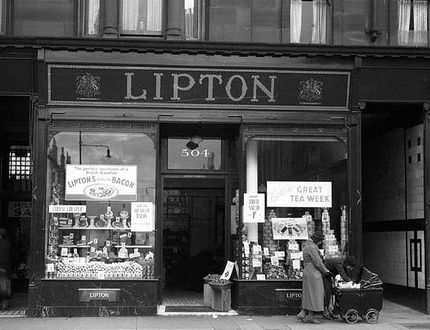
Lipton shopfront 1

By 1895 the boy from the Glasgow slums had achieved much. Now aged 46 he was already a millionaire, lived on a sixty acre estate well beyond the north London suburbs, had opened his extensive London offices in City Road, had a chain of grocery shops across Britain, had businesses and properties in America, and owned tea and rubber estates in Ceylon. But while his Lipton shops and his advertising stunts were often the subject of news reports and leaders in the provincial press not one mention can be found of Thomas Lipton the man in the archives of “The Times”- not that is until 1896. This was to be a pivotal year for Lipton, the society shunning businessman who often claimed “I advertise my business, not myself.”

Ten years earlier Tommy in one of his typical advertising stunts had offered Queen Victoria a five ton cheese – “the most marvellous product of dairy enterprise of all ages” – to celebrate Her Majesty’s Golden Jubilee. Doubtless he was not surprised to find his offer “Respectfully declined” on the grounds that the Queen could not accept presents from private individuals to whom she was not personally known. Many newspapers criticised his offer and rejoiced in the perceived snub, though Lipton relished the publicity that once again attracted even more customers to his stores. Who then would have guessed that before the century closed Tommy Lipton would kneel at the Queen’s feet and arise as Sir Thomas?

Some claim that Lipton’s debut into the limelight was in 1895 when he received the Royal Warrant to supply Queen Victoria with tea. But that still was recognition of Lipton tea rather than Lipton the man. How much his elevation into English high society was a happy accident or a shrewd business plan can only now be guessed at. But for certain the branding of Thomas Lipton required exactly the same consummate marketing skills that built his business.

The story begins in April 1896. Lipton was fresh back from a trip to his beloved estates in Ceylon and read in The Times an open letter from Princess Alexandra, the Princess of Wales, to the Lord Mayor of London. In this letter she pleaded for commemoration of the Queen’s Diamond Jubilee not by the erection of yet another statue but by helping “the poorest of the poor in the slums of London” suggesting “let us provide these unfortunate ones, these poor beggars and outcasts with a substantial meal during the week of the Jubilee celebrations” and as well as encouraging the Lord Mayor to do this in all parts of London, she sent her personal cheque for £100.

Thomas Lipton shunned society but was not reclusive; he spent no money on himself but poured it avidly into his business that was both his hobby and his life. He had a generous nature, particularly when giving involved receiving some publicity. As he had done many times before to such appeals he offered all the tea and sugar that the Princess Alexandra Appeal could use – and he noted with satisfaction the public response to his generosity. Later, on being thanked by Sir George Faudel Phillips, the Lord Mayor, Lipton enquired how the fund was going and learned that of the £30,000 required only a fraction had been received. Just as now public charity then was subject to “disaster fatigue” and appeals had recently been raised for Welsh miners, for the Indian famine, and for wounded Greeks: as a result the Princess’s shilling fund organised in the Daily Telegraph was not doing well. On hearing this Thomas Lipton made a decision that was to change his life – he took up his pen and wrote a cheque for £25,000 (equivalent to two million pounds today) – handing it to the Lord Mayor on the sole condition that it be an anonymous donation. Tommy Lipton had great sympathy with the poor, he had been raised in a slum, and had clawed his way out; his pity acknowledged that he could still be trapped there.

Lipton also knew full well the way the press would respond to news of a last minute anonymous benefactor: the public curiosity, the speculation, the feverish hunt to put a name to the deed. The press responded as he expected and, as he had already donated in kind and had no reputation for giving out cash, speculated excitedly and inaccurately about the unknown donor. After ten days when the hunt was at its height Lipton allowed the Lord Mayor to release his name – and the press reacted with even greater vigour. Here was a story indeed! When interviewed Tommy responded with tales of his early life and struggle to build his business, and his stunts: elephants hauling tea from the docks, the gold sovereigns in the monster cheeses, the orphan pigs and the fake bank notes promising the bearer good bacon, ham and cheese at Lipton’s shops. Very soon he was supervising the organisation of the Fund’s dinners for 400,000 persons – to each a one pound meat pie, a two pound loaf, four ounces of cheese and half a pound of cake, ginger beer and lemonade and of course Lipton tea. Just to deliver the 700,000 kilograms of food parcels to halls around London took four hundred removal vans. The Dinner was hailed an outstanding success. ‘Jubilee Lipton’ as he was dubbed was again interviewed by an avid press, and revealed that he was engaged on an even larger scheme – the Alexandra Trust – to alleviate poverty by supplying cheap wholesome food to the poor. Lipton had already contributed a further £100,000 to this new work and was now unquestionably, just three short months after his return from Ceylon and without effort, a major celebrity. More curious still, while having shown no discernable previous interest in royalty, he had earned the deep and sincere gratitude of the wife of the future King of England.

Queen Victoria’s New Year’s Honours List of 1897 included Her Majesty’s solicitor, two of Her Majesty’s doctors, three of Her Majesty’s colonial officials – and at the personal request of Princess Alexandra, Her Majesty’s grocer. The press cooed congratulations. Vanity Fair – a Victorian version of OK Magazine – observed that he was “an excellent amiable fellow and trade was properly honoured in him”.

Yes, life had certainly taken a new turn for Sir Thomas Lipton – but would celebrity fame turn his head?

Next Part -how Sir Thomas the grocer captivated London’s diamond studded high society, and launched a flotilla of racing yachts.

Tea Hero – Sir Thomas Lipton Part 2.

Lipton’s hard slog years: realising the dream; becoming the man.

In the first part of Tommy Lipton’s story we saw him depart for the USA as a callow youth and four years later return to Glasgow having learned some valuable life skills, with US$ 500 in his pocket, an iconic bushy moustache and the dream of building a grocery empire.

Tommy made his homecoming truly triumphant – it was talked about afterwards for months – he had brought back for his mother a barrel of flour and a rocking chair so, hiring a horse cab, he tied these to the roof and paid the driver to drive slowly through the neighbourhood while he leaned out of the window shouting greetings and waving to all. That exultant return was on Saturday, but on the following Monday he was again working as his father’s assistant in the family basement grocery shop, and the slow pace of work after a bustling New York department store deadened him. He agreed with his father that “Quality tells” – but quality told all too slowly for Tommy’s liking. He had seen marketing in full swing in America and had plans to shake the public, to amaze them, to entrance them . . . but his father had no time for smart Yankee ways in his shop. Tommy needed to open a second shop on his own account.

Tommy always carried with him a few pounds in gold sovereigns – he believed in the motivating effect of a cash down payment – and, passing the Glasgow dock area heard of a ship from Philadelphia that had been delayed by bad weather. The owners were selling off the cargo on the quay to ensure a swift turnaround and Tommy bought a consignment of hams and bacon which he managed to sell in town and make an £18 profit. This set him thinking; if he could do this with a small outlay think what he could make from investing £100. And if one shop could make £5 a week he reasoned with his parents, two could make £10 and twenty could make £100 – why not a shop in every town in Scotland? But Tommy’s father, having dragged himself up from poverty to the security of his own tiny shop was not minded to risk expansion. Not so his son who, in 1871 on his 23rd birthday and with his mother’s blessing unrolled his plan and opened up his first shop – in a classier suburb of Glasgow than his parent’s shop. Typically Tommy always with an eye to a good news story told the local papers that it was his coming of age 21st birthday.
130 years before dot com booms, bankers’ bonuses and football superstars, money had to be made slowly and by hard work. In Tommy’s case by very hard work – and advertising – and “stunts”. It took him 30 years to build his shop empire – “softly, softly, catchee monkey!” – and his business methods were always impeccable. He was never accused of any dodgy dealing, he never borrowed money, he paid cash on the nail, he lived for his work and he re-invested every penny into the business. In his autobiography (published a year after his death) he remembered “I worked late and early. I was manager, shopman, buyer, cashier and messenger boy. If I had provisions to collect off the Irish boat I went down to the quay early in the morning with a handcart; if customers wanted goods delivered I would shut up the shop temporarily and take them in person”. After closing time he would work on the accounts and think up new selling ideas. Occasionally, dog tired, he would sleep the night under his own counter.

Tommy Lipton had several secrets to success. He sold good quality goods at lower prices than his competitors – by underpaying himself and (this was to become his slogan) by cutting out the middleman. He went straight to producers and bought for cash on the spot. But perhaps his most successful “secret” was showmanship. His shop was bright and attractive and he commissioned a weekly cartoon poster for the window. A memorable one was an Irishman carrying a weeping pig over his shoulder, while explaining to an onlooker that the pig was an orphan as all the rest of the pig’s family had gone to Lipton’s and out of pity he was taking him there too! Soon Tommy acquired large two porkers that he scrubbed and tied ribbons in their tails and had them driven though Glasgow – a different route each day – under the banner “Lipton’s Orphans” and painted on their sides “I’m going to Lipton’s, the best shop in town for Irish bacon”.

Tommy Lipton’s first shop assistant William Love started work on a six month contract but before it expired he had opened a second shop and the assistant became assistant manager – and remained as Lipton’s right hand man and fixer for 40 years.
Lipton was a genius at promotion and later in his career would refer to himself – in the style of a circus performer – as The Great Lipton. In 1877 a typical Lipton stunt was having fake bank notes printed and handed out in the streets declaring “I promise to give on demand in any of my establishments HAM, BUTTER and EGGS as given elsewhere to the value of one pound, for fifteen shillings”. An ingenious discount that generated a mass of trade; however fraudulent passing of Lipton’s fake but very realistic notes resulted in several court cases and Tommy obligingly withdrew them; but they had amply achieved their purpose.
By the start of the 1880s Lipton had shops in a dozen northern cities and their citizens, egged on by the press, were constantly wondering “What Lipton’s would be doing next?” Perhaps the most talked about of hundreds of stunts was the import of the largest cheeses ever made. In 1881 amidst great publicity at every stage he ordered two three tonne cheeses to be made in America. The public was fascinated by the production of these monsters and Tommy fed the newspapers minute by minute details – 4,000 gallons of milk was required; 800 cows were milked for 6 days; 200 milkmaids were employed; world cheese experts were consulted. The huge cheeses were destined for Christmas sale in Glasgow and Edinburgh. The Edinburgh cheese first travelled south from Glasgow Port by rail and was displayed for a week at the London Royal Aquarium, the Victorian equivalent of the O2 Arena, and famous for attracting crowds to concerts, plays and circus acts.

The Glasgow cheese, by now dubbed “Jumbo” after an 18ft tall celebrity elephant at London Zoo, was hauled from the dock by traction engine at maximum speed (then 4 mph with a man walking ahead with a red flag) and quickly attracted a thousand followers, eager to see what Lipton was up to now. However on reaching his flagship High Street shop it was discovered that the door was too narrow, and so was the window. Lipton, sitting astride the cheese announced that it would now be displayed at his larger Jamaica Street shop, and so the entourage again slowly proceeded across Glasgow, stopping traffic and attracting publicity throughout the day.

When Jumbo was installed Lipton worked on how to milk further publicity from his cheese. His plan was to cut and sell it on Christmas Eve and to ensure a crowd advertised that, like the traditional silver threepences in Christmas puddings, Lipton’s Jumbo would contain gold sovereigns. On Christmas Eve a mass of customers crowded round the shop, controlled by special squad of policemen. Tommy Lipton, wearing his trademark black suit and crisp white apron personally cut cheese for eager customers who immediately rummaged through their purchase. Every time the shout went up that a gold coin had been found more customers crowded in while those who had been unlucky pressed through the doors to purchase more. Within two hours every crumb of the three tonne cheese was sold.

Giant cheeses containing gold coins were to become a feature of Lipton shops at Christmas for many years after and always with a new publicity angle. In 1893 at the Chicago Fair Lipton caused a stir by purchasing the Canadian exhibit – this time a twelve tonne cheese – but on subsequent arrival in Glasgow this monster proved by its aroma to be well past its best by date. Lipton rejoiced in the publicity, and claimed on the insurance.

Twenty years of building his fleet of shops hardly changed Tommy Lipton; every month his business grew larger and his workload was undiminished. But the source of his encouragement; his beloved and devoted mother was aging and died at 80 in the autumn of 1889. Tommy was distraught at her loss and threw himself into work even harder. When in the following spring his father also died Tommy was advised to take a holiday. He complied and booked a passage to Australia. History shows however that he had other plans than to take a restful vacation – he had sent ahead an aide to sound out commercial prospects in Ceylon (now Sri Lanka) where he broke his voyage.

While Lipton’s grocery shops were best known for their Irish hams, eggs, butter and cheese they naturally supplied other provisions too – sugar, jams, meat pastes, coffee – and tea. In those days tea was displayed in bulk and weighed and packed to order. Lipton purchased his tea as he did his sugar, from an importer. What he discovered in Ceylon was to change his company, his life, and certainly the history of tea. Ceylon like China and India exported tea to Great Britain but was very much the new boy on the block. Ceylon had been a coffee growing country until coffee rust devastated the crop and was just picking up speed as a tea producer. Agricultural land prices were still depressed from the coffee crash and Tommy had gone on “vacation” with £75,000 to invest…

In Part Three: Lipton turns Ceylon tea into a brand – and emerges as a socialite.