Nearly all black teas are pressure treated to initiate oxidation which requires the miniscule chloroplasts in the green leaf cells to be “popped” to release the enzyme polyphenoloxidase that catalyses the oxidation of green catechins to form orange theaflavins (which then polymerize into brown thearubigins) – to make a typical black tea. Popping the chloroplasts requires a lot of pressure – this was originally done manually and now, in Orthodox processing, the pressure is provided by a rolling table.
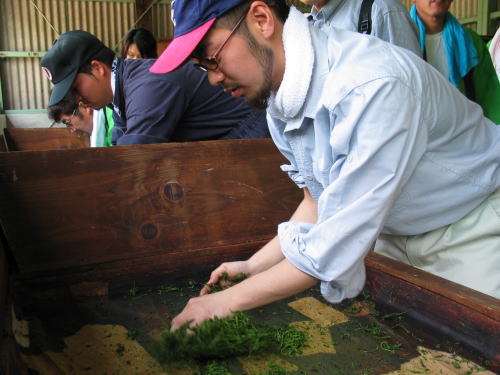
Traditionally in China green leaf was hand rolled between the palms of the hands rotating them anticlockwise ninety degrees out of sync. In Japan – see photograph to the right – green leaf was hand rolled backwards and forwards between the hands and a flat surface. Thus in China hand rolling gives a twist and curl to the leaf – ultimately giving the well known gunpowder pellet. The orthodox rolling table, particularly the double acting type, is based on this rotating hand action and is used both for green and black tea manufacture. In Japan the forwards-backwards hand motion produces cylindrical needles, and modern Japanese green tea machinery mimics this hand action and product format.
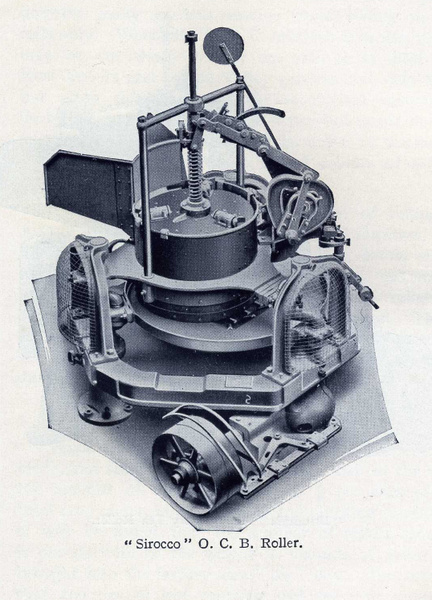
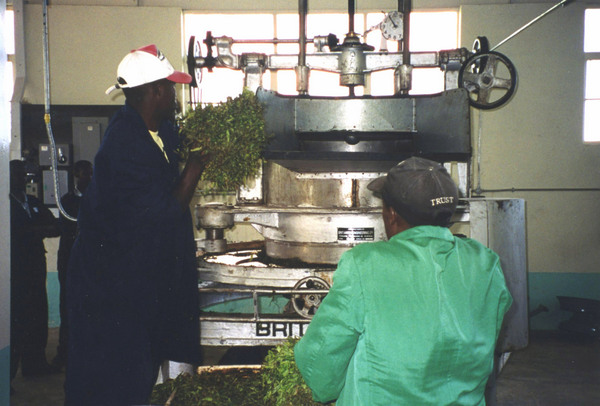
Rolling tables were first introduced by the British in the 1880’s as factory sizes grew, and to take advantage of developments in steam power and oil engines. The basic design has not changed to this day – a flat table some 2 metres across bearing an eccentrically rotating drum containing around 300 kg of withered leaf, and a pressure cap on the drum to squeeze the leaf – see photograph above of a British built Sirocco rolling table from the 1920’s: this would have been leather belt driven from overhead lay shafting probably powered by a central oil engine. It clearly shows the table, the drum and the pressure cap. Modern tables are very little different except that they are driven by electric motors – they are still hand loaded and – see photograph below of a new Indian built machine installed in Kenya in 2002 – and still called Britannia!
Within the moving drum the leaf travels in a torroidal motion – imagine a doughnut ring with the leaf moving around the ring and also spirally from outer edge to inner and round again – this movement squeezes leaf hard against the table, the drum sides and the pressure cap in turn. Pressure is increased further in some rolling tables by putting crescent shaped battens on the table and a cone in the centre.
Typically a charge of leaf is rolled for 20-30 minutes and then sifted. Fine particles that fall through the sieves are collected for the next stage – Oxidation, while large unbroken leaf is returned to the rolling table for a further roll. In Sri Lanka it is not unusual for there to be four rolls in sequence, each under increasing pressure.
The rolling induced chloroplast popping action is helped by Withering (discussed in the May 2007 NBT Newsletter); withering weakens the cell membranes allowing the chloroplast to rupture with less pressure, thus black teas are withered, but green teas that do not require oxidation are not. The heavy rolling pressure required to induce oxidation – particularly with battens and cone as seen above – not only pops the chloroplasts but also breaks the shoot into pieces and curls and twists it giving character and style. The leaf pieces are ultimately sorted into the well known tea grades of commerce. Pekoe (P) may have some whole leaf but no tips. Orange Pekoe (OP) is primarily twisted stem, and no tips. Flowery Orange Pekoe (FOP) may have curled leaf pieces and some tip. Tippy grades come from the first sifting which removes the tender buds and tips; broken grades are smaller pieces derived primarily from the later rolls.