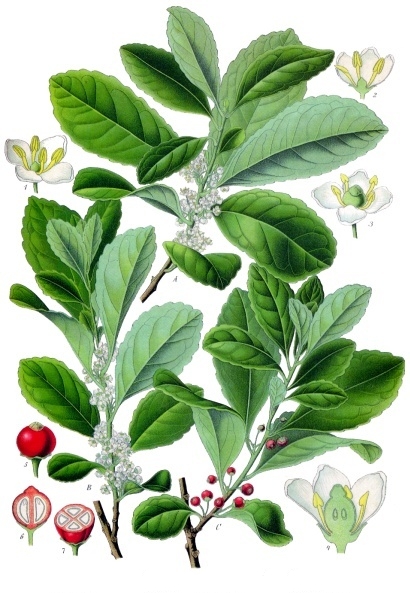
The natives of South America were drinking several caffeine containing beverages long before the Conquistadors came ashore. Chief of these was Mate, made from the leaves of a small evergreen tree, a species of Holly (Ilex paraguariensis) native to subtropical Argentina, eastern Paraguay, western Uruguay and southern Brazil. While maté is the common spelling in English and indicates the proper pronunciation, it should be remembered that in Spanish maté is the first person singular past tense of the verb matar = to kill, thus meaning [I] killed (!)
Huge amounts of mate are consumed in South America where communal mate drinking follows a traditional ritual just as complex as the Japanese Tea Ceremony; though modern pressures of life mean that city dwellers carry their mate with them to sip throughout the day, just as the Chinese do with their green tea.
Mate is infused by steeping the dry leaves (and twigs) in hot water, rather than in boiling water like black tea; as with green tea it is generally considered too bitter if steeped in water at boiling point. Traditionally, and when drinking with friends the infusion is made very strong in a hollow gourd – also called a mate in Spanish, thus Yerba mate literally means Gourd or Cup Herb. A metal straw (a bombilla) with a filter in the base is used to sip the infusion as the gourd is passed round the group. At frequent intervals the infusion is topped up with hot water by the appointed hostess. As well as in Argentina, Bolivia, Uruguay, Paraguay, South Brazil and parts of Chile you may find the mate ritual performed in Syria and Lebanon, both countries that import huge amounts of green mate leaf.
Much as with tea, one can purchase flavored mate in many varieties, and in Brazil green mate is toasted to produce a very popular milder beverage known as chá mate, sold in teabag and loose form, and served, sweetened, in specialized shops, either hot or iced with fruit juice or milk, and even as a soft drink. The toasted variety of mate has less of a bitter flavor and more of a spicy fragrance and is mostly consumed in the coastal cities of Brazil as opposed to the far southern states where green mate is preferred in the traditional way.
In Paraguay, green yerba mate is also drunk as a cold beverage. Usually drunk out of a cow’s horn in the countryside, tereré, as it is known in the Guaraní language, is served with cold or iced water. Medicinal herbs, known as “yuyos”, are mixed in a mortar and pestle and added to the water for flavouring or medicinal reasons.
Mate bushes are grown on plantations much as are tea bushes, very little is now collected from the wild. The plant is cultivated and processed mainly in northern Argentina, Paraguay, Uruguay and southern Brazil. World production is around 300,000 tonnes per annum, the largest exporter is Argentina, shipping around 60,000 tonnes to neighbouring countries and to the eastern Mediterranean. Mechanical harvesting is common and the 40 to 50 cm long branches are dried in a factory. Traditionally this was done over a wood fire, imparting a smoky flavor. When dried the leaves are stripped and twigs are broken up to form crude green mate which is stored for 12 months to mellow the taste. Before sale the crude raw material is sorted – there are many grades and types of yerba, with and without twigs, and with varying powder content – each type has its devotees. The sex of the mate bush can also determine strength of the leaf flavour, caffeine level and other nutrients, depending on whether it is a male or female plant. Female plants tend to be milder in flavour, and lower in caffeine, though on commercial plantations it is the male bush that is favoured for planting.
The caffeine content of mate is relatively low – from 0.3% to 1.9% of dry weight (compare this to 2.0–5.0% for tea leaves, and 2.0% for ground coffee). However, the custom of brewing mate very strong in the gourd and then progressively diluting the beverage as it is communally consumed makes actual caffeine intake difficult to estimate compared to a single cup of coffee or tea.
Yerba mate contains natural antioxidants and various studies are showing it to exhibit significant cancer-fighting activity. Researchers at the University of Illinois (2005) found yerba mate to be “rich in antioxidant phenolic constituents” and to “inhibit oral cancer cell proliferation”. Emerging research also shows that yerba mate preparations may be useful in treating heart disease.
In addition to the Green Mate, we also stock a range of flavoured Mates. Moroccan Mate, Magic Mate, Sweet Mate, Sunrise and the Punchy Devils Mate.