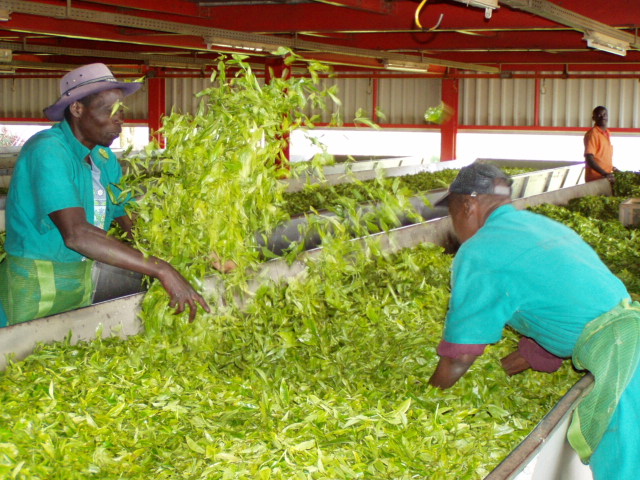
When plucked fresh in the field tea leaves are crisp and if rolled in the hand will break up into flakes. Rolling machinery in the tea factory needs a soft pliable material to form into the stylish curled and twisted shapes that are typical of premium teas. Withering, at least in the sense that a teaman uses the word, means gently losing moisture from the fresh leaf until the resulting withered leaf is limp and ready for the rolling stage. This means losing some 25 to 50% of the weight of the fresh leaf as evaporated water, and the process takes around 18 hours.
Before we consider exactly what happens in withering we should be clear which teas do and don’t need withering to develop their character.
Green Teas – no wither. Pliable leaf is achieved by steaming (Japanese green teas) or by parching – dry heating in a wok (China green teas)
All other teas require withering, but the style of this varies.
White Teas – very slow and gentle wither often initially in sunlight and then under shade, in thin layers, for up to three days.
Oolong Teas – also begin with 1 or 2 hours of sun withering, then into shade for 16 hours during which time the leaf is “fluffed” many times by hand to gently bruise it.
Black Teas – leaf for these used to be thinly spread on tats (banks of mesh trays) but now it receives 16 to 18 hours of drying on special troughs that allow warmed air to be blown through the bed of leaf until the correct moisture content is achieved.
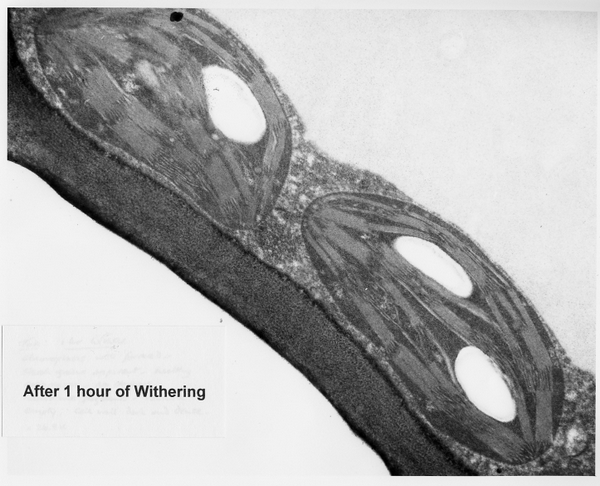
Fresh leaf photosynthesizes in sunlight and produces glucose. Further biosynthesis produces a range of compounds that are temporarily stored in the leaf cells as starch and proteins and fats. Loss of water during withering causes the leaf to mobilize its stored reserves converting them to sugars amino acids and lipids – all of which are essential for the development of aroma volatiles and flavours during the rolling and oxidation processes.
This electron microscope photograph of two chloroplasts in a tea leaf cell after 1 hour of withering clearly shows large white starch grains – stored carbohydrate which will be fully solubilized into sugar within 8 or 10 hours. There are about 200 tiny chloroplasts in each leaf cell and each one is a biochemical powerhouse.
After 13 hours withering the chloroplast shows no starch grains but dark staining lipid globules can be seen as the leaf’s fat reserves are also solubilized.
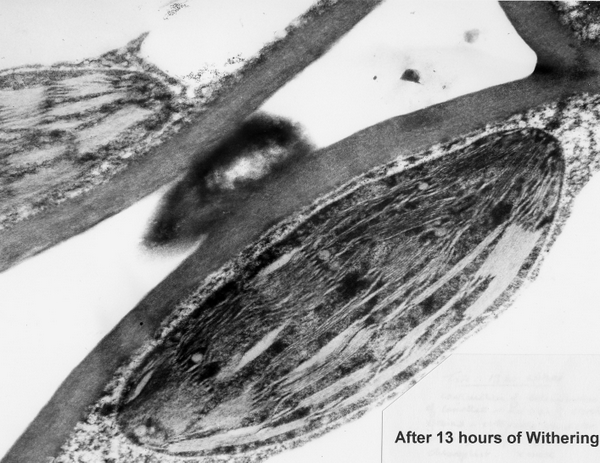
At this stage the leaf is almost ready biochemically for oxidation, but withering usually continues to around 16-18 hours to ensure that the leaf is physically ready for rolling or cutting.
The amount of moisture lost from the leaf determines to a great extent the type of tea that will be produced:
Soft wither – little water loss – strong pungent and coloury black CTC teas of Assam and Africa
Medium wither – moderate water loss – orthodox black teas of Assam and Ceylon low country teas with more aroma than CTC teas
Hard wither – much water loss – Ceylon high grown teas with pronounced aroma and flavour
Very hard wither – extreme water loss to the point where some leaf is too dry to oxidize and remains green in the made tea – Darjeelings and Nepals with world famous aroma
Tea tasters can tell just by looking at and tasting the finished tea whether the withering process has been carried out correctly in the factory. Some of the clues to bad withering are:
Harsh metallic taste – wither too short, not enough moisture loss
Flakey leaf – if black and flakey then wither too short (too soft) and if green and flakey then wither too long or too hard
Acid fruity aroma and taste – often due to bacterial growth when rain wetted leaf is withered too slowly or not dried before withering
Plain tasting tea grey in the cup – over long or over hot wither