
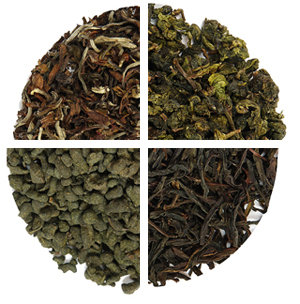
Oolongs
Oolong tea is semi oxidised, though the degree of oxidation varies from maker to maker.
Oolongs have extra steps (compared with black and green teas) in the withering stage that help develop its characteristic aroma.
The freshly plucked green leaves are first spread out in the sun for a couple of hours before being transferred to the withering trough inside the factory. During the moisture loss stage, the leaf is tossed by hand many times, which causes slight bruising and the production of aroma volatiles - these are the parts of the tea's taste that you sense through your nose rather than in your mouth.
Oolong tea is also often given a final firing at higher temperatures to further develop a typical oolong flavour.
Whites
White tea receives the simplest processing of any tea. The very finest young shoots are spring plucked while they are still immature. The buds and young leaves are covered with fine down which gives dry white tea its characteristic colour.
The best white tea is made by simply allowing the leaf to dry under well ventilated and shaded conditions, gently turning it at intervals to ensure even drying. If the weather is poor, drying takes place indoors using slightly warmed air.
White tea production can take up to three days to complete. When it's done correctly this slow process naturally depletes the cellular polyphenol-oxidase enzyme that causes rapid oxidation in black and oolong tea, and which must be killed by heat to stop the process when making green tea. Thus the best white teas require the highest skill from the tea maker and are inevitably among the most expensive.
Yellows
Yellow tea processing varies considerable by region. The goal of a yellow tea is to minimise the grassy flavour that is a common characteristic of green teas. Small amounts of green leaf are quickly roasted, then the hot leaf is smothered by wrapping it in cloth or paper, which allows it to cure in its own steam. It's either left in the paper until it is dry or it is removed and rolled into needles and then dried. Some regions allow slight oxidisation. The leaves themselves often look very yellow and produce a golden yellow liquor characterised by a dominant fruity, flowery aroma. Chemically, Yellow Tea differs from Green Tea as the smothering process degrades green chlorophyll into yellow brown pheophorbide, a breakdown product with anti-tumour properties.
Pu Erhs
Tea was often transported out of China on horseback - a journey that took many months. The tea was carried in baskets and as it moved through humid and tropical climates, it absorbed moisture and fermented. Modern Pu Erh production mimics and tightly controls these conditions of temperature and storage to optimise quality.
There are two kinds of Pu Erh tea: raw and cooked. The raw Pu Erh type is produced very simply. The tea is picked, withered and fired and then compressed into cakes which are wrapped in paper and allowed to age. The tea slowly ferments as it absorbs moisture from the air. Raw Pu Erh can taste good when young if it is not too astringent or harsh but its quality and value will be enhanced by long storage. As with wine, choosing a Pu Erh that will age well requires skill: it is important to choose one with an assertive taste and aroma but without any unpleasant or unnatural flavours. A really enjoyable Pu Erh may have been aged for ten or twenty years.
Cooked Pu Erh - in the 1970s the concept of cooked Pu Erh was created to accelerate the aging process of vintage raw Pu Erh. After picking and withering, the leaf is heaped up and allowed to rest under moist conditions for 40 days. This encourages the right fungal and bacterial fermentation.
Cooked Pu Erh is often shunned by purists who believe it is inferior to the raw variety. However, when made with care and aged well a cooked Pu Erh can be outstanding.

This part of our site does not use cookies, or store any tracking information on your computer. However, if you go to the shop we will need to use cookies in order to keep track of what you've added to your shopping basket, and some other essential information. To learn more about cookies and online tracking, you can check out the ICO pages.