The post Tea Tasting appeared first on Tea Musings.
]]>Today was a really good tasting day. Highlights include:

Yuan Shan Yin Zhen
An speciality from the Hunan province. Yellow Silver Needles. Which had a really interesting depth of flavours. It takes a lot of tea buds to make and is at the higher end of the tea price spectrum.
Next was a batch of oolongs
All of which were very different colours in the cup. All of which were delicious in different ways. There was one from Nepal, one from Indonesia, China, Formosa and Thailand. All of which were delicious.
I think this has to be one of the most visual teas I have come across. Looks amazing and tasted very interesting, with clean soft green notes, and a smokiness which smoothed the flavours together. Not an everyday green tea, but certainly would make a great end to a meal or be an afternoon highlight.
Last but not least was this tea,

Wild Tea Buds
Yunnan Wild Tea buds. These are harvested from wild tea trees. It does not look very interesting in the cup, the liqour is just a few shade away from looking like water. However it is packed with flavour yet light and clean and having just had a second cup cold would bf fabulous in the summer chilled. This is definitely one of my new favourite teas.
Now I just need to work out how I am going to get all these lovely new teas in the building!
The post Tea Tasting appeared first on Tea Musings.
]]>The post Tea Hero – Sir Thomas Lipton Part 2. appeared first on Tea Musings.
]]>In the first part of Tommy Lipton’s story we saw him depart for the USA as a callow youth and four years later return to Glasgow having learned some valuable life skills, with US$ 500 in his pocket, an iconic bushy moustache and the dream of building a grocery empire.
Tommy made his homecoming truly triumphant – it was talked about afterwards for months – he had brought back for his mother a barrel of flour and a rocking chair so, hiring a horse cab, he tied these to the roof and paid the driver to drive slowly through the neighbourhood while he leaned out of the window shouting greetings and waving to all. That exultant return was on Saturday, but on the following Monday he was again working as his father’s assistant in the family basement grocery shop, and the slow pace of work after a bustling New York department store deadened him. He agreed with his father that “Quality tells” – but quality told all too slowly for Tommy’s liking. He had seen marketing in full swing in America and had plans to shake the public, to amaze them, to entrance them . . . but his father had no time for smart Yankee ways in his shop. Tommy needed to open a second shop on his own account.
Tommy always carried with him a few pounds in gold sovereigns – he believed in the motivating effect of a cash down payment – and, passing the Glasgow dock area heard of a ship from Philadelphia that had been delayed by bad weather. The owners were selling off the cargo on the quay to ensure a swift turnaround and Tommy bought a consignment of hams and bacon which he managed to sell in town and make an £18 profit. This set him thinking; if he could do this with a small outlay think what he could make from investing £100. And if one shop could make £5 a week he reasoned with his parents, two could make £10 and twenty could make £100 – why not a shop in every town in Scotland? But Tommy’s father, having dragged himself up from poverty to the security of his own tiny shop was not minded to risk expansion. Not so his son who, in 1871 on his 23rd birthday and with his mother’s blessing unrolled his plan and opened up his first shop – in a classier suburb of Glasgow than his parent’s shop. Typically Tommy always with an eye to a good news story told the local papers that it was his coming of age 21st birthday.
130 years before dot com booms, bankers’ bonuses and football superstars, money had to be made slowly and by hard work. In Tommy’s case by very hard work – and advertising – and “stunts”. It took him 30 years to build his shop empire – “softly, softly, catchee monkey!” – and his business methods were always impeccable. He was never accused of any dodgy dealing, he never borrowed money, he paid cash on the nail, he lived for his work and he re-invested every penny into the business. In his autobiography (published a year after his death) he remembered “I worked late and early. I was manager, shopman, buyer, cashier and messenger boy. If I had provisions to collect off the Irish boat I went down to the quay early in the morning with a handcart; if customers wanted goods delivered I would shut up the shop temporarily and take them in person”. After closing time he would work on the accounts and think up new selling ideas. Occasionally, dog tired, he would sleep the night under his own counter.
Tommy Lipton had several secrets to success. He sold good quality goods at lower prices than his competitors – by underpaying himself and (this was to become his slogan) by cutting out the middleman. He went straight to producers and bought for cash on the spot. But perhaps his most successful “secret” was showmanship. His shop was bright and attractive and he commissioned a weekly cartoon poster for the window. A memorable one was an Irishman carrying a weeping pig over his shoulder, while explaining to an onlooker that the pig was an orphan as all the rest of the pig’s family had gone to Lipton’s and out of pity he was taking him there too! Soon Tommy acquired large two porkers that he scrubbed and tied ribbons in their tails and had them driven though Glasgow – a different route each day – under the banner “Lipton’s Orphans” and painted on their sides “I’m going to Lipton’s, the best shop in town for Irish bacon”.
Tommy Lipton’s first shop assistant William Love started work on a six month contract but before it expired he had opened a second shop and the assistant became assistant manager – and remained as Lipton’s right hand man and fixer for 40 years.
Lipton was a genius at promotion and later in his career would refer to himself – in the style of a circus performer – as The Great Lipton. In 1877 a typical Lipton stunt was having fake bank notes printed and handed out in the streets declaring “I promise to give on demand in any of my establishments HAM, BUTTER and EGGS as given elsewhere to the value of one pound, for fifteen shillings”. An ingenious discount that generated a mass of trade; however fraudulent passing of Lipton’s fake but very realistic notes resulted in several court cases and Tommy obligingly withdrew them; but they had amply achieved their purpose.
By the start of the 1880s Lipton had shops in a dozen northern cities and their citizens, egged on by the press, were constantly wondering “What Lipton’s would be doing next?” Perhaps the most talked about of hundreds of stunts was the import of the largest cheeses ever made. In 1881 amidst great publicity at every stage he ordered two three tonne cheeses to be made in America. The public was fascinated by the production of these monsters and Tommy fed the newspapers minute by minute details – 4,000 gallons of milk was required; 800 cows were milked for 6 days; 200 milkmaids were employed; world cheese experts were consulted. The huge cheeses were destined for Christmas sale in Glasgow and Edinburgh. The Edinburgh cheese first travelled south from Glasgow Port by rail and was displayed for a week at the London Royal Aquarium, the Victorian equivalent of the O2 Arena, and famous for attracting crowds to concerts, plays and circus acts.
The Glasgow cheese, by now dubbed “Jumbo” after an 18ft tall celebrity elephant at London Zoo, was hauled from the dock by traction engine at maximum speed (then 4 mph with a man walking ahead with a red flag) and quickly attracted a thousand followers, eager to see what Lipton was up to now. However on reaching his flagship High Street shop it was discovered that the door was too narrow, and so was the window. Lipton, sitting astride the cheese announced that it would now be displayed at his larger Jamaica Street shop, and so the entourage again slowly proceeded across Glasgow, stopping traffic and attracting publicity throughout the day.
When Jumbo was installed Lipton worked on how to milk further publicity from his cheese. His plan was to cut and sell it on Christmas Eve and to ensure a crowd advertised that, like the traditional silver threepences in Christmas puddings, Lipton’s Jumbo would contain gold sovereigns. On Christmas Eve a mass of customers crowded round the shop, controlled by special squad of policemen. Tommy Lipton, wearing his trademark black suit and crisp white apron personally cut cheese for eager customers who immediately rummaged through their purchase. Every time the shout went up that a gold coin had been found more customers crowded in while those who had been unlucky pressed through the doors to purchase more. Within two hours every crumb of the three tonne cheese was sold.
Giant cheeses containing gold coins were to become a feature of Lipton shops at Christmas for many years after and always with a new publicity angle. In 1893 at the Chicago Fair Lipton caused a stir by purchasing the Canadian exhibit – this time a twelve tonne cheese – but on subsequent arrival in Glasgow this monster proved by its aroma to be well past its best by date. Lipton rejoiced in the publicity, and claimed on the insurance.
Twenty years of building his fleet of shops hardly changed Tommy Lipton; every month his business grew larger and his workload was undiminished. But the source of his encouragement; his beloved and devoted mother was aging and died at 80 in the autumn of 1889. Tommy was distraught at her loss and threw himself into work even harder. When in the following spring his father also died Tommy was advised to take a holiday. He complied and booked a passage to Australia. History shows however that he had other plans than to take a restful vacation – he had sent ahead an aide to sound out commercial prospects in Ceylon (now Sri Lanka) where he broke his voyage.
While Lipton’s grocery shops were best known for their Irish hams, eggs, butter and cheese they naturally supplied other provisions too – sugar, jams, meat pastes, coffee – and tea. In those days tea was displayed in bulk and weighed and packed to order. Lipton purchased his tea as he did his sugar, from an importer. What he discovered in Ceylon was to change his company, his life, and certainly the history of tea. Ceylon like China and India exported tea to Great Britain but was very much the new boy on the block. Ceylon had been a coffee growing country until coffee rust devastated the crop and was just picking up speed as a tea producer. Agricultural land prices were still depressed from the coffee crash and Tommy had gone on “vacation” with £75,000 to invest…
In Part Three: Lipton turns Ceylon tea into a brand – and emerges as a socialite.
The post Tea Hero – Sir Thomas Lipton Part 2. appeared first on Tea Musings.
]]>The post Tea Hero – Sir Thomas Lipton Part One appeared first on Tea Musings.
]]>Lipton never smoked or drank, nor ever married. He never gambled yet took enormous commercial chances. As a household name familiar enough to be caricatured as Mr Tea in a popular stage play he shaped Victorian retail history, yet he took no part in politics, science, art or literature – asked once what his politics were he replied “To open a new grocery shop every week”. Until his forties he was virtually friendless and had no hobbies, often sleeping under his own counter rather than go home, yet he was to enter society as ‘one of the most eligible bachelors in the world’ and would become a close and discreet friend of King Edward VII. Without ever learning to sail he built and unsuccessfully raced five expensive yachts against the USA. Lipton was a man who had by his own endeavour raised himself from poverty to high society and who passionately believed in the power of self-help – yet left a million pounds in his will to the poor of Glasgow. A clue to the Lipton riddle can perhaps be found in one of his many after dinner speeches: “A man may have many friends, but he will find none so steadfast, so constant, so ready to respond to his wants, so capable of pushing him ahead, as a little leather covered book with the name of his bank on the cover.” This philosophy explains almost his every action – but his early life clearly shows the influencing factors that drove and enabled Mr Tea to achieve his empire.
Thomas Lipton’s parents fled the 1847potato famine leaving County Down for the slums of Glasgow. Engels after visiting the Gorbals in the 1840s wrote “I did not believe that so large an amount of filth, crime, misery and disease existed in one spot in any civilised country.” Tommy was born in 1848 during a cholera epidemic that killed 4,000 Glaswegians including his four year old sister Frances. Little wonder that to survive one had to be tough. Young Tommy thrived on the local turf wars: fist fights and narrow escapes from the police. Once he stood up to the local bully, a butcher’s son, who had been demanding protection money from children in the form of marbles. Tommy hadn’t a chance against the well fed bully and eventually his friends pulled him, battered and bloody, away from the fight. Lipton always remembered the lesson; that though he had lost the fight he had gained far more in admiration and respect. He recalled in later life “my stock soared high among all the boys of the district.”
The Clyde was all about shipbuilding and small boys in Glasgow made paper sailed models of sailing ships. Tommy organised his gang – the Crown Street Clan – in racing their toy yachts for marbles on the flooded abandoned clay pits. Tommy’s yachts were always called Shamrock.
Tommy’s family lived a precarious life. His father like many others was thrown out of his box printing job by the import trade downturn due to the American Civil War. Facing destitution, Thomas Senior, with his wife Frances set up a tiny grocery in their tenement basement selling fresh provisions shipped from friends with a farm in Ireland. Tommy left school at 13 and helped out in the shop, every week going to the dock with his barrow to collect the ham, eggs and butter from the steamer – never thinking that his name would in his lifetime be synonymous with groceries – and thereafter with tea. Yet his marketing genius was beginning to show in his advice to his father that “Mother should sell the eggs, as her hands are smaller, so it makes the eggs look larger.”
Glasgow was a busy port as well as a ship building city. A boy growing up on the Clyde heard sailors tales about far places and, throughout his young life saw waves of desperate migrants set sail for a better life in the New World. Tommy tried his hand at several jobs – printer’s errand boy and cutter in a shirt factory – but already six feet tall and strong, chafed against being confined in a routine low paid job. Through his contacts at the dock he heard that the Burns Line was looking for a cabin boy on its Belfast to Glasgow ferry. Despite this being hard work, waiting on sea passengers’ every whim, it doubled his pay and with meals on duty gave him the travel and freedom he craved. But the seventeen year old’s time on the Irish sea came to an abrupt halt when the chief steward discovered that Tommy had let a paraffin lamp go untrimmed overnight: the tell-tale smoke stain on the white ceiling betraying that his mind was on other things – listening to the old hands talking endlessly about the Americas – so Tommy was dismissed. However, long hours and free food aboard had built up some cash and his next act after collecting his pay was to invest five pounds in a steerage ticket for the SS Caledonia bound for New York. Many such lads, with stars in their eyes, slipped quietly away from family duties to make their fortunes, but through choice or failure never made the long voyage home again. Whole initially considering this as an option Tommy’s strong ties with his family ensured his winning their support, so he went with their blessing and parting tears. Without doubt Lipton saw his adventure as a necessary step on the path to success. He would later recall “The parting was sad, but my mother, at least, had such faith in me that she believed I would soon return a rich man”
Leaving behind the wretched conditions below deck for 300 migrants in steerage on a small steamer tossed for 14 days on the choppy North Atlantic, Tommy disembarked to earn his first dollar on US soil. Unencumbered by baggage he was soon off the ship and fell in with an Irish lodging house keeper. For a week’s free keep he undertook to fill Mike McCauligan’s beds and soon, back on the dock and, promising the “the best house in town” while relieving them of 10 cents a head, he shepherded a dozen of his bewildered fellow travellers to McCauligans dubious rooms.
Much like Glasgow, in 1866 the overpopulated poor areas of New York were cess pits of filth, disease and crime; recently exacerbated by the influx of 20,000 demobilised Union Army soldiers. Lipton’s first task was to find employment but in a trading city faced with war ravaged loss of markets, teeming with returned soldiers and hopeful immigrants, the competition was severe. Despite the many attractions of New York Lipton faced the reality of his precarious position and rather than spiralling down into drink and squalor as did so many immigrants, decided to go south to Virginia, where the Civil War and abolishment of slavery had caused labour shortages on the plantations. However he found that tobacco farm hands were worked just as hard as the slaves had been but, true to form, Tommy Lipton took on extra duties and saved a little money. He might have continued there but for an accident with an axe that nearly severed his foot. Nursed back to health by his employer’s wife, Tommy decided on a change of scene and gained a job on a South Carolina rice plantation where his literacy and rudimentary book keeping skills gained him a clerk’s position. Coincidentally the rice plantation was very close to where, a century later, T.J Lipton Inc. as part of Unilever, would set up their tea research station, now owned by the Bigelow family and operated as Charleston Tea Farm – “America’s only commercial tea garden”
Back in New York Tommy was to place his foot on a significant rung of the ladder to his success: he landed a job in a Scottish department store. The owner A.T Stewart whose commercial success came from his compulsive competitive drive, rigorous staff discipline and attention to detail would inspire the young Lipton. He took well to retailing, enjoyed selling groceries to customers, and noted the influence of Stewarts’ presentation of goods and the effect of customer service – and the power of advertising. The observant Lipton’s two years’ of 12 hour days in various departments at Stewarts was today’s equivalent of an MBA. Macy’s too was thriving just a block away. Macy was a friend of circus owner PT Barnum who dreamed up many of Macy’s advertising stunts and aggressive promotions. Tommy saw and absorbed all this and, with $500 in his pocket (a large sum then) and the bushy moustache that would soon make him instantly recognisable, he returned to his parents in Glasgow determined to become a merchant showman – and millionaire
Next week Part 2: bizarre stunts, opening up a new shop every week, and venturing into tea.
The post Tea Hero – Sir Thomas Lipton Part One appeared first on Tea Musings.
]]>The post Meet Natela – Our Georgian Old Lady appeared first on Tea Musings.
]]>
During Soviet times Natela worked at the local State Tea Farm. When long ago she married a village boy her new mother-in-law taught her to pluck tea and, over the years she progressed to field supervisor. Her sister was also a tea worker at the tea factory and was sent to China as part of her training. All the tea produced in Georgia was destined for the samovars of Soviet Russia so while surrounded by tea during the day the factory workers had no tea to drink at home – and security at the factory was strong. However, the fields were unguarded and, like many of their fellow tea workers Natela and her sister would steal green leaf from the bushes at the weekend and hand make tea at home. Just as now the green leaf would be withered in the shade of a farmhouse veranda and when ready would be put into the washing bowl for hand rolling. On to overnight oxidation covered with a damp towel and then out into the strong Georgian summer sun to dry.
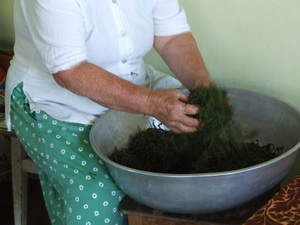
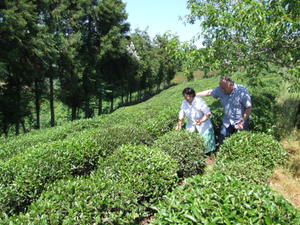
Since Georgia’s independence in 1991 Natela has taught a whole new generation of her fellow villagers to hand make tea and many are now members of the Georgian Hand Made Tea Makers Association. Some use small locally made electric powered rolling tables to do the hard work of rolling but Natela still crafts her teas completely by hand. In a year she can produce about 220lbs all of which is purchased by More Tea Ltd. Natela’s granddaughter is now at university and, unlike it was in Soviet times, this is no longer free. With the proceeds of her tea sales Natela is paying her granddaughter’s university fees – when she graduates Natela thinks she may retire – but it’s difficult to believe.
The post Meet Natela – Our Georgian Old Lady appeared first on Tea Musings.
]]>The post TEA TALK: A Safari through Kenyan Tea appeared first on Tea Musings.
]]>Kenya is situated on the east coast of Africa, a tropical country straddling the equator, the warm Indian Ocean to the east, and huge fresh water Lake Uganda to the west. Note that fifteen other African countries are also tea producers large and small – though Kenya produces more tea than all the rest added together – last year topping 300,000 tonnes for the first time.
Tea is naturally a plant of the moist tropics. On the equator and at sea level the temperatures are far too hot for tea to grow. Fortunately, Kenya has plenty of high land on both sides of the Rift Valley where, at elevations from 4,500 up to 7,000 feet the air is cool and rainfall is plentiful; combined with the rich acid volcanic soils the intense natural light and high humidity, the conditions are ideal for tea. In Kenya the tea growing conditions uniquely combine quality with quantity. In the 400 square miles that are carpeted with tea there are over 1 billion tea bushes growing, and every one of those bushes is visited every ten days by a trained tea plucker who selects just the newly grown tips for harvest. No harvesting machines operate here – just human skill. At 1,500 tips per kilogram a plucker will select and pluck over 30,000 per day! The Kenya tea industry is vast and, because it is labour intensive, it can achieve the very best quality.
The ongoing peaks and dips in tea prices at the Mombasa auction affect a lot of lives. Out of Kenya’s 25 million population over 12% are involved in the tea industry in some capacity, and half a million are directly employed in producing tea. KTDA – the Kenya Tea Development Agency, is a huge co-operative of small tea farmers established in 1965 (before then only multinational companies were allowed to grow tea). Now KTDA has 430,000 individual farmers growing and selling green leaf to the 55 tea factories it manages. An amazingly complex and successful undertaking that operates effectively despite all the problems found in a developing country.
Kenya was a late comer into the world tea scene with the earliest commercial plantings made in the 1920’s – compare this with China’s 5,000 tea history, Indonesia from the 1700’s, Indian production from 1830, and Sri Lanka from 1870. Brooke Bond still pluck from the original bushes planted just north of Nairobi. Commercial production took off exponentially in the 1930’s and now Kenya teas feature in virtually all UK tea blends. Kenya’s spectacular export growth is the more impressive when compared with India for example where growth in exports has only been 20% in 70 years (160,000 tonnes exported annually in 1930’s and 210,000 tonnes per annum now). To support this spectacular and consistent growth the Kenya industry has pioneered and perfected many innovations in tea production, like the withering trough, continuous fermentation, the CTC and the fluid bed drier, and giant tea factories that give economy of scale.
Multinational companies grow about 40% of the Kenyan tea with small farmers under KTDA guidance growing the bulk. KTDA has 55 out of the total tea 98 factories. Kenya’s tea factories are on average four times as large as those in Sri Lanka and six times as big as those in Assam.
At the tea auction that is held in Mombasa every Monday and Tuesday, tea is sold by the producers and is bought by local and international packers. Big names Lipton, Brooke Bond, Van Rees are represented there, plus many small brokers and traders. Before the auction commences they will have seen and tasted tea samples from each of the lots and will bid for their requirements. Some 70% of Kenya’s tea passes through this auction with the remainder sold by private treaty. The Mombasa auction attracts tea from surrounding countries too – Uganda, Tanzania, Malawi, Burundi and Rwanda. All these are then shipped worldwide from Mombasa port for blending and packing in consuming countries.
Of the 300,000 tonnes of Kenya tea produced only 7% is retained for local drinking. For the rest there are three main customers – UK, Pakistan, and Egypt, who together purchase nearly three quarters. US consumption of Kenya tea is very small – of the 46 billion cups drunk in USA only 800 million are grown in Kenya. The main reason for this small uptake is that Kenya grows high quality CTC black tea. This is ideally suited to England’s “strong tea with milk and sugar” taste but is not so popular with Americans and most Europeans who drink their teas without milk. Prior to WW2 the US drank equal amounts of green and black tea of orthodox manufacture; but since then tastes have changed towards iced tea that now forms 70% of the US tea market.
With the rising popularity of the teabag Kenya has since the 1970’s (as has the rest of Africa) concentrated solely on black CTC tea – but globally this is fast becoming an oversupplied and stagnating market. KTDA is known for making the very best quality of CTC teas and has recently diversified into producing fine specialty leaf teas using traditional orthodox tea equipment imported from India.
The post TEA TALK: A Safari through Kenyan Tea appeared first on Tea Musings.
]]>The post TEA TALK: Getting to Grips with Japanese Tea appeared first on Tea Musings.
]]>Tea brought originally as seeds from China has been grown in Japan for over 800 years and a Japanese tea culture soon grew up, based originally on the ancient Chinese methods, utensils and traditions but, particularly during the 16th Century, was refined to reflect a period of flourishing Zen Buddhist based Japanese cultural development. The tea ceremony (Chanoyu), tea masters, tea schools (including Urasenke) and exquisite ceramic tea utensils date back to this time. Chado (The Way of Tea) then reached its purest form under the influence of artist Sen Rikyu (1522-1591) with its highly aesthetic and ritualised tea ceremony recognising the beauty of ordinary life. The basis of Chado is Harmony – expressed in four written characters:
Kei Reverence – respect for all things and beings
wa Harmony and Peace – deeply felt, honest sympathy with everything and everybody
sei Purity – inner and outer purity in thought, deed and word
jaku Quietness
When, by following the tea ceremony ritual, this state of Harmony is reached then the final goal – Tranquillity – is achieved.
Technically the history of Japanese tea has evolved through three main stages – Boiled Tea, Whipped Tea and Steeped Tea. Originally Japanese tea was made into compressed cakes for transport and storage – the tea at this time was manufactured as parched green tea using the technique learned in China. Cake tea was broken into pieces and boiled to reconstitute it. At some time in the 15th Century steaming was introduced and Japanese tea manufacture could then produce a very bright green product; eventually this crude leaf tea was powdered by grinding between stones instead of being pressed into cakes. This powdered tea (Matcha) was used for making Whipped Tea – frothed by whipping the powdered tea and hot water with a bamboo whisk. This is method still central to the tea ceremony. Finally, in the 18th Century a tea seller in Kyoto developed an entirely new method of rolling and rubbing steamed leaves by hand on a hot surface. The method produced needles of rolled leaf (Sencha) that retained a better flavour and colour and made possible the steeping of tea in a tea pot. Steeped tea developed its own much less formal ceremony (Sencha-do) which became particularly popular among literary artists who prized freedom under the hierarchical feudal system of the period.
Japan has many types of green tea the names of which reflect how the tea was grown, the type of leaves used in its manufacture, the method of manufacture, how the tea is sorted and any final processing it received. When you understand the meaning of these tea names it makes choosing a Japanese tea much more interesting than a black tea, whose name tells nothing about its process history. In our next Newsletter we will explain the essential sensory differences between Kukicha and Kokeicha, Kabusecha and Konacha, but for the moment we look at the broad manufacturing methods used that give the major different tea types.
Growing Method – Japanese tea farmers unlike any others shade some of their bushes with bamboo mats (now mainly black nylon shade material) for three weeks to increase chlorophyll and amino acid development in the young leaf. The very best teas – Gyokuro and Tencha are shade grown teas (Matcha is produced by grinding Tencha leaves). Sencha is grown in full sun and has a more bitter, less sweet taste.
Age of Leaf – young leaf makes the best tea. Japanese farmers harvest their bushes four times during the growing season (four flushes) and the first or Spring flush (Ichibancha) is the best quality. Tea made from very mature or coarse Autumn leaf produces Ban-cha.
Initial Heating – for green tea production the leaf enzymes must be destroyed or the green leaf will ferment (oxidise) to produce black tea. Most Japanese tea is steamed, but a small amount is still “pan fried” or roasted in the Chinese manner – Kamairi-cha is an example of Japanese pan fired tea – rolled into round shapes. The very rare Kamanobi-cha is pan fired and then rolled into needles.
Rolling – now, except for very expensive hand made Japanese teas, all are machine rolled. A distinction is made between needle shape (Sencha and Kamanobi-cha) and round shape (Ryoku-cha and Kamairi-cha).
Unlike teas made in countries under former British influence the manufacture of all Japanese tea is made in two stages – first the Crude Tea Process, usually undertaken in small factories operated as cooperatives where the tea is produced and dried but not graded (Aru-cha). The Refining Process which takes place in tea dealers’ central factories produces by repeated sifting, standardised leaf teas called Hon-cha and stalk teas called Ban-cha.
The post TEA TALK: Getting to Grips with Japanese Tea appeared first on Tea Musings.
]]>The post Tea Types – Oolong Tea appeared first on Tea Musings.
]]>The process method can vary dramatically between different oolongs – just as with black teas. We describe here the production of premium Phoenix Oolong from the Phoenix Mountains of northern Guangdong in Fujian Province where the warm moist Pacific air and the high elevation combine to make ideal conditions for high quality tea plantations.
The tea bushes grow at around 1,300 to 1,500 metres in damp air and mist, in soil that rarely dries out. Many of the bushes are propagated from very old trees that have been famed over the years for producing high quality teas. Some even can be traced back to the Sung Dynasty of 600 years ago, when oolong was first manufactured.
The best Phoenix tea is made in small village factories by tea masters – traditionally skilled craftsmen, each of whom guards his secret methods. Bushes are plucked around mid day when the leaf surface has lost its dew coating, unlike premium green teas where cool damp early morning leaves are preferred. Plucking at noon allows a couple of afternoon hours for the harvested leaf to be spread in thin layers and withered in the sun – an essential step for developing oolong character. Leaves are turned several times during sun wither to ensure that all are equally exposed to the hot sun light. Then the leaves are collected and cooled, and spread in the shade. During that evening and through the night the tea master will fluff and rub the leaves briefly by hand for a five minute period every 1 to 2 hours. Each time the massaging is done with more vigour so that, by the end of fermentation each leaf margin is reddish, while the leaf centre is green. During this stage essential volatiles are produced that give the oolong liquor its characteristic taste and aroma. Judging the extent and timing of fermentation demands great skill as it is affected by weather conditions before and after plucking and by the plucked leaf quality. The fermentation is halted by roasting the leaf in a large wok, traditionally charcoal fired but now more often electrically heated. This end of this brief drying process is judged by smell and it makes the leaf soft and pliable, ready for twisting. Exceptional quality oolongs are still hand twisted, but many villages have introduced small rolling machines. Phoenix oolong is a hard twisted leaf that liquors slowly and retains is flavour through several brewings.
Final drying is done in baking basket over wood charcoal, for five to ten minutes with a rest time of one or two hours in-between when the tea master will check progress.
This long and painstaking manufacture is typical of the very best village manufactured oolongs, but many fine oolongs are also made in larger tea factories in Fujian. All are a living link with the Sung Dynasty.
Now is the time, if you haven’t tasted it yet, to try our Phoenix Dancong?
The post Tea Types – Oolong Tea appeared first on Tea Musings.
]]>The post White Tea appeared first on Tea Musings.
]]>White tea is the rarest type of tea because of its limited availability. What separates white tea from black, green and oolong is the way it is made – carefully selected plants plucked gently at dawn with the dew fresh on the leaf, and manufactured by hand with natural wither and drying using sunlight.
Like green tea, White tea is unfermented but fermentation is avoided by gentle handling rather than by steaming or roasting. Initial drying is done in the morning sun, followed by gentle hand rolling to give some curl to the leaf but not hard enough to break the cells and cause fermentation. The leaf is then dried completely in the strong afternoon sun. White tea is rare and expensive because of the skilled hand making involved, and because conditions are only right for making it at certain parts of the year.
More Tea is always seeking new and unusual sources for tea. While white tea has traditional been from China, we have stocked small quantities of white tea from many other sources over the years. Malawi, Zimbabwe, Turkey, Sri Lanka, where they are made in very small quantities.
The post White Tea appeared first on Tea Musings.
]]>The post Tea Talk – Withering appeared first on Tea Musings.
]]>Before we consider exactly what happens in withering we should be clear which teas do and don’t need withering to develop their character.
Green Teas – no wither. Pliable leaf is achieved by steaming (Japanese green teas) or by parching – dry heating in a wok (China green teas)
All other teas require withering, but the style of this varies.
White Teas – very slow and gentle wither often initially in sunlight and then under shade, in thin layers, for up to three days.
Oolong Teas – also begin with 1 or 2 hours of sun withering, then into shade for 16 hours during which time the leaf is “fluffed” many times by hand to gently bruise it.
Black Teas – leaf for these used to be thinly spread on tats (banks of mesh trays) but now it receives 16 to 18 hours of drying on special troughs that allow warmed air to be blown through the bed of leaf until the correct moisture content is achieved.
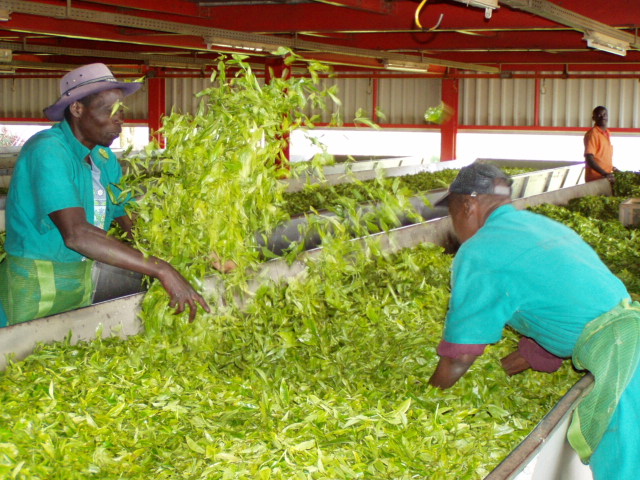
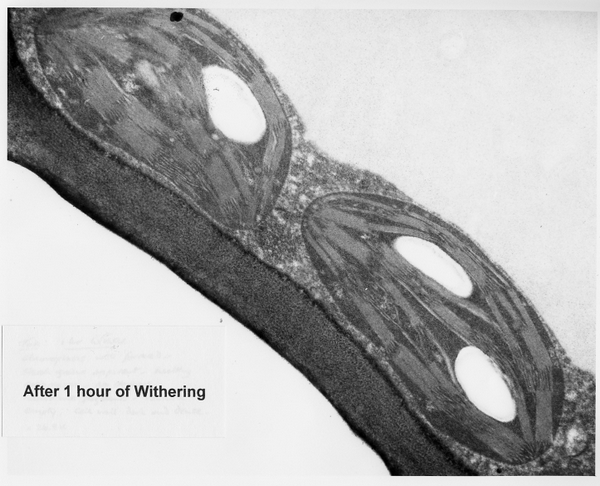
Fresh leaf photosynthesizes in sunlight and produces glucose. Further biosynthesis produces a range of compounds that are temporarily stored in the leaf cells as starch and proteins and fats. Loss of water during withering causes the leaf to mobilize its stored reserves converting them to sugars amino acids and lipids – all of which are essential for the development of aroma volatiles and flavours during the rolling and oxidation processes.
This electron microscope photograph of two chloroplasts in a tea leaf cell after 1 hour of withering clearly shows large white starch grains – stored carbohydrate which will be fully solubilized into sugar within 8 or 10 hours. There are about 200 tiny chloroplasts in each leaf cell and each one is a biochemical powerhouse.
After 13 hours withering the chloroplast shows no starch grains but dark staining lipid globules can be seen as the leaf’s fat reserves are also solubilized.
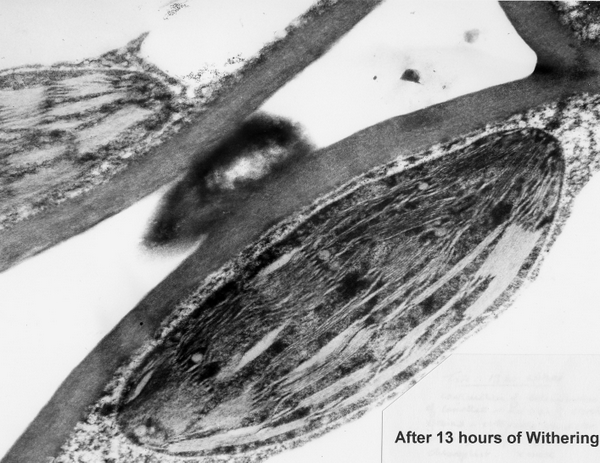
At this stage the leaf is almost ready biochemically for oxidation, but withering usually continues to around 16-18 hours to ensure that the leaf is physically ready for rolling or cutting.
The amount of moisture lost from the leaf determines to a great extent the type of tea that will be produced:
Soft wither – little water loss – strong pungent and coloury black CTC teas of Assam and Africa
Medium wither – moderate water loss – orthodox black teas of Assam and Ceylon low country teas with more aroma than CTC teas
Hard wither – much water loss – Ceylon high grown teas with pronounced aroma and flavour
Very hard wither – extreme water loss to the point where some leaf is too dry to oxidize and remains green in the made tea – Darjeelings and Nepals with world famous aroma
Tea tasters can tell just by looking at and tasting the finished tea whether the withering process has been carried out correctly in the factory. Some of the clues to bad withering are:
Harsh metallic taste – wither too short, not enough moisture loss
Flakey leaf – if black and flakey then wither too short (too soft) and if green and flakey then wither too long or too hard
Acid fruity aroma and taste – often due to bacterial growth when rain wetted leaf is withered too slowly or not dried before withering
Plain tasting tea grey in the cup – over long or over hot wither
The post Tea Talk – Withering appeared first on Tea Musings.
]]>The post Tea Talk – Rolling appeared first on Tea Musings.
]]>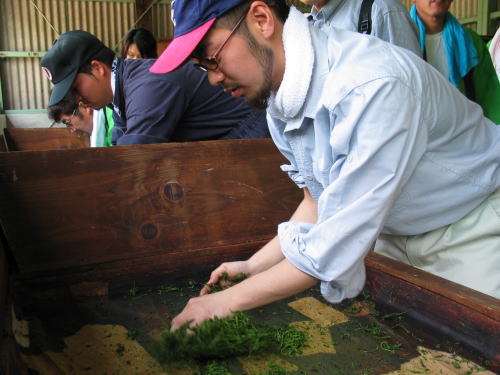
Traditionally in China green leaf was hand rolled between the palms of the hands rotating them anticlockwise ninety degrees out of sync. In Japan – see photograph to the right – green leaf was hand rolled backwards and forwards between the hands and a flat surface. Thus in China hand rolling gives a twist and curl to the leaf – ultimately giving the well known gunpowder pellet. The orthodox rolling table, particularly the double acting type, is based on this rotating hand action and is used both for green and black tea manufacture. In Japan the forwards-backwards hand motion produces cylindrical needles, and modern Japanese green tea machinery mimics this hand action and product format.
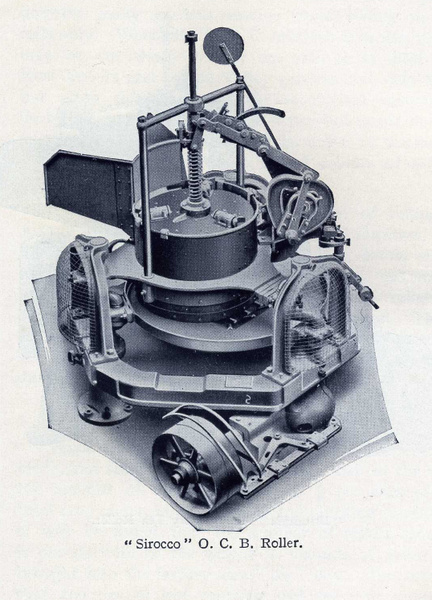
Rolling tables were first introduced by the British in the 1880’s as factory sizes grew, and to take advantage of developments in steam power and oil engines. The basic design has not changed to this day – a flat table some 2 metres across bearing an eccentrically rotating drum containing around 300 kg of withered leaf, and a pressure cap on the drum to squeeze the leaf – see photograph above of a British built Sirocco rolling table from the 1920’s: this would have been leather belt driven from overhead lay shafting probably powered by a central oil engine. It clearly shows the table, the drum and the pressure cap. Modern tables are very little different except that they are driven by electric motors – they are still hand loaded and – see photograph below of a new Indian built machine installed in Kenya in 2002 – and still called Britannia!
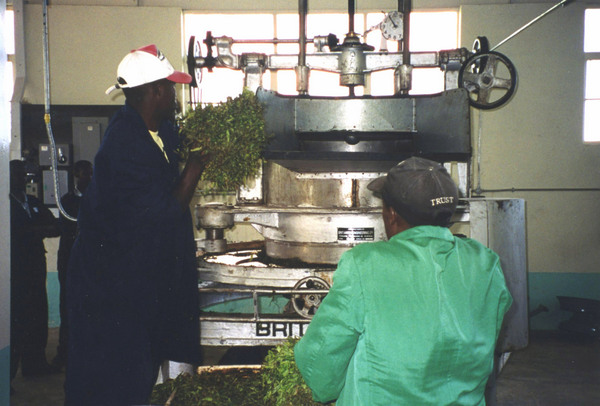
Within the moving drum the leaf travels in a torroidal motion – imagine a doughnut ring with the leaf moving around the ring and also spirally from outer edge to inner and round again – this movement squeezes leaf hard against the table, the drum sides and the pressure cap in turn. Pressure is increased further in some rolling tables by putting crescent shaped battens on the table and a cone in the centre.
Typically a charge of leaf is rolled for 20-30 minutes and then sifted. Fine particles that fall through the sieves are collected for the next stage – Oxidation, while large unbroken leaf is returned to the rolling table for a further roll. In Sri Lanka it is not unusual for there to be four rolls in sequence, each under increasing pressure.
The rolling induced chloroplast popping action is helped by Withering (discussed in the May 2007 NBT Newsletter); withering weakens the cell membranes allowing the chloroplast to rupture with less pressure, thus black teas are withered, but green teas that do not require oxidation are not. The heavy rolling pressure required to induce oxidation – particularly with battens and cone as seen above – not only pops the chloroplasts but also breaks the shoot into pieces and curls and twists it giving character and style. The leaf pieces are ultimately sorted into the well known tea grades of commerce. Pekoe (P) may have some whole leaf but no tips. Orange Pekoe (OP) is primarily twisted stem, and no tips. Flowery Orange Pekoe (FOP) may have curled leaf pieces and some tip. Tippy grades come from the first sifting which removes the tender buds and tips; broken grades are smaller pieces derived primarily from the later rolls.
The post Tea Talk – Rolling appeared first on Tea Musings.
]]>