The post Tea Heroes – Sir Thomas Lipton Part Seven appeared first on Tea Musings.
]]>In our last Newsletter, we left Sir Thomas busily contributing to the war effort and Shamrock IV, built in 1914, safe in her wartime berth in Brooklyn. The Lipton Company prospered during the war as Sir Thomas maintained his usual high public profile, tirelessly campaigning and fund raising around the country for the Tank Bank, which built thousands of the new-fangled machines that helped shorten hostilities. Despite wartime food rationing, Lipton managed to return dividends to shareholders at pre-war levels.
Lipton fully intended to continue his quest for the America’s Cup. He joked with reporters that he “had to drink his tea from a saucer” as he was unable “to lift the cup”. In 1920, the first race of the post war series lined the snub-nosed, green-hulled Shamrock IV against the American yacht Resolute. Tens of thousands of spectators took to the water to watch the race amidst a media circus; reporters chased the yachts in a US Navy airship, and events were transmitted across the Atlantic within minutes by “wire-photo” – an early form of fax. The rules required that Resolute be allowed a seven minute start on Shamrock IV due to the latter’s larger sail area. Nevertheless, Shamrock won the race, mainly due to Resolute breaking a mainsail halyard. Characteristically, Sir Thomas refused to celebrate a victory based on an accident. But to wild acclaim, even from Americans, Lipton also won the second race, finishing nine minutes ahead, or twominutes with the handicap. To take home the Cup however, Shamrock IV needed a third win – and in this race, though pipping Resolute by half a minute, the result went to Resolute on the handicap, as did the fourth race. With a decider to sail for, the fifth race was postponed by the judges due to rough weather – which Shamrock IV was built for. Next day, extreme calm favoured Resolute and she won convincingly. This was the closest Lipton, or indeed anyone, had so far come to wresting the Cup from America. But the Americans loved his sportsmanship, and in the 3 days after the final race, 35,000 people flocked to visit Shamrock IV in dock.
Lipton was to mount just one more challenge for the elusive Cup. The keel of Shamrock V was laid in 1929 to the new J-class rules hammered out after years of negotiation on America’s Cup yacht design. Shamrock V was a fast and graceful vessel but the US defender Enterprise incorporated latest aircraft technology and ergonomics into its build, and obsessive man management into its crewing. Despite what seemed to be the entire US nation willing Lipton to win, the races went in favour of Enterprise. Film star Will Rogers, in his weekly newspaper column, urged Enterprise’s captain, Mike Vanderbilt, to give Lipton a win “if Vanderbilt wants to make himself an American hero.” But Vanderbilt was driven by competition rather than by popularity – and Shamrock V was well defeated. A wave of emotion swept America, which had turned to sport to relieve the ache of the Great Depression. Many Americans argued for the Cup to be presented to Sir Thomas anyway. Will Rogers called for a loving cup to mark Lipton’s five unsuccessful events. Franklin D Roosevelt – then a State Governor – sent a donation with the message “Sir Thomas and his good sportsmanship are a lesson to every American.” Silver miners in Utah sent 25kg of silver which was used by Tiffany’s to form the base for a solid gold loving cup – the Lipton Trophy. New York Mayor Jimmy Walker suggested the inscription: “To possibly the world’s worst yacht builder, but absolutely the world’s most cheerful loser.” Later that year, in New York’s City Hall, Sir Thomas, with uncharacteristic tears, received the trophy with accolades from Mayor Walker. He was now 82 years old.
Although Lipton had captained his company well during the war years and soon afterwards returned good dividends for shareholders, the commercial waters had become choppy by the mid-1920s. The chain of 500 Lipton shops that had before seen no real competition were now facing new rivals: Sainsbury’s, Home and Colonial, David Greig’s and Maypole were fast becoming household names. Sir Thomas Lipton, whose autocratic methods had worked well in building the company, could not adjust to the rules of corporate management – he had no tolerance for less than perfect and was often arbitrary in his decisions. Lipton was Managing Director and still the largest shareholder but despite that, the Lipton Ltd annual meeting of 1926 was stormy: his fellow directors forced him out of control by promoting him sideways to the ineffectual position of “Life President and Chairman”. Lipton resisted retirement for six months but finally agreed to depart, having negotiated sale of his shares to the Van den Burgh group for a seven figure termination fee that would drop the jaw of even a modern banker.
Thereafter Sir Thomas concentrated on his wholly-owned American companies, managing them in his accustomed style. His office was at the top of the huge Lipton warehouse on the Hudson River at Hoboken, New Jersey. This had a car-sized lift and Sir Thomas would be chauffeur driven into the lift and whisked to his office, stepping out of his car and straight to his desk. It was from this office in 1930 that he masterminded his last challenge for the America’s Cup.
Sir Thomas died at home from a respiratory infection in the summer of 1931 just eight months after receiving the golden loving cup from his American admirers. He bequeathed Osridge, his London home of fifty years, to be used as a retirement home for nurses. His 84 volume scrapbook of press cuttings and photographs recording his amazing life, his yachting trophies, and the remains of his fortune – almost a million pounds – he donated to the sick and poor of Glasgow. The gold Lipton Trophy loving cup he deeded back to the New York Yacht Club.
His iconic name lives on in the tea brand that globally still outsells all others, yet it is not retailed in the UK. How can that be?
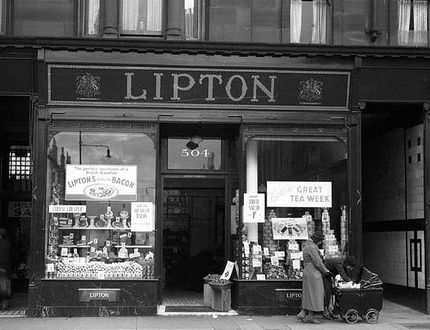
The chain of Lipton grocery stores of UK Lipton Ltd were merged in 1929 with Home and Colonial Stores to form a 3,000 shop chain of grocers and tea merchants. Home and Colonial traded until 1961 when, to reflect the passing of the British Empire, it rebranded itself as Allied Suppliers. The Lipton store name continued in the UK as a small town supermarket chain until it was acquired first by the Cavenham Group in 1972, and then the Argyle Group in 1982 who rebranded Lipton stores as Presto when Argyle merged with Safeway UK.
The post Tea Heroes – Sir Thomas Lipton Part Seven appeared first on Tea Musings.
]]>The post Tea Heroes – Sir Thomas Lipton Part Six appeared first on Tea Musings.
]]>Tommy Lipton, sprung from Scottish Irish stock knew how to tell a good joke and an intriguing story. Edward Prince of Wales was not much of a conversationalist and sought out companions who could readily amuse him; a woman must be beautiful and amusing, a man rich and amusing. Lipton the man was both and an ideal companion – twinkling eyed Irish humour, devoid of class consciousness, his own master all his life, a millionaire who had never owed a penny, no chip on his shoulder – and full of lively charm. Added to this Lipton came with no encumbrances; no skeletons in his cupboard. He had no wife, no divorce, no relatives and no old friends. He was rich, he was friendly, a raconteur, good company and generous, and as he was beginning to show through his ocean racing, a “jolly good sport”.
Friendship with Bertie gave him open invitations to Buckingham Palace and Balmoral, Sandringham and Windsor, and the royal yacht at Cowes. He also became a friend of Princess Henry of Battenberg, ex Empress Eugenie, the King of Italy and Alfonso of Spain – who proposed to Princess Ena aboard Lipton’s steam yacht Erin. Lipton routinely put the Erin at the disposal of his royal and titled friends for cruises and parties, high jinks and trysts. Lipton as a favour to the Prince of Wales discretely created a job in his American business for George Keppel, husband of Bertie’s last and most glamorous mistress, Mrs Alice Keppel, so effectively providing her with an income and keeping her husband safely out of England. Thus, as friend and confidant of the Prince and subsequently the King, and through his business connections, Sir Thomas enjoyed the cream of English and American society throughout the remarkable Edwardian era.
Nevertheless, the Grocer did not let his business slide. His UK company paid shareholders good yearly dividends of 15% and he continued to expand his US business with shrewd dealings that impressed even the hard-nosed Americans. One deal in the Chicago stockyards where Lipton had cornered the pork futures market made him a cool $300,000. A local newspaper printed “Sir Thomas, you’re a bird. You don’t roar when we beat your sailboat, so we won’t chew the rag when you get even in a commercial way”. Lipton took a 20 year lease on a large six storey property in New York that became his US headquarters. It was to house his first complete tea packing plant there and became a launching pad for similar operations across the country. The Thomas J Lipton & Co business in America, unlike Lipton Ltd in the UK, remained under his sole control and all its profits were his own wealth.
At home Lipton was however already planning another ocean racing bid and soon launched Shamrock II as the challenger for the 1901 America’s Cup. Lipton lavishly entertained celebrities aboard the Erin and Alice Keppel was his hostess. Socialite Mrs Dana Gibson wrote to a friend “I took a real fancy to Lipton. He is so good natured and such a boy.” Columbia beat Shamrock II in all three races, but narrowly, in the total of ninety miles there was only three and a half minutes between their times.
Undaunted, and reminding listeners that “the shamrock has three leaves” Lipton soon laid the keel of Shamrock III for the 1903 series. At 14,000 square feet of sail she was to be his fastest boat yet, and the most expensive. Before the first race Sir Thomas lunched with President Theodore Roosevelt at the White House and acted as judge in a beauty contest – cleverly avoiding making a final choice (and thereby increasing his admirers) by saying of the final two contenders “It’s impossible for me to arrive at a decision as to which is the more beautiful lady – the one is perfectly charming, while the other is delightfully bewitching.” and presented each with a small golden shamrock. Unfortunately the race went badly for Shamrock III with Reliance easily winning every heat, but Lipton though privately deeply disappointed, took defeat lightly in public – where he jokingly complained that he had to drink his tea from a saucer as he was “unable to lift the cup.”
The death from pneumonia of Edward VII in 1910 marked the end of a glorious era – auspicious display, gaiety and frivolity. His son, now George V, was a different man and unlikely to surround himself with men of commerce such as the Rothschilds, the Sassoons, and Sir Thomas. Lipton however continued to serve his former royal friend Bertie by inviting Alice Keppel to stay at Dambatenne Estate in Ceylon as a refuge from publicity. Although Alexandra had invited his mistress to see Edward as he lay dying she was no longer welcome after his death. Mrs Keppel and her daughter Violet stayed in Dambatenne for three months while the press interest declined. Violet wrote later: “I shared a room with a tame snake and a wild governess.”
In the seven years since the inglorious rout of Shamrock III Lipton had taken up ocean racing with a vengeance and very successfully performed at English regattas and abroad. In 1910 he won six cups which were presented to him by Kaiser Wilhelm at the Kiel Regatta – and he had the Kaiser, noted for his ill humour, roaring with laughter over stories of his Glasgow youth. Diplomats were stunned at Lipton’s ability to put people at their ease but Lipton was now 60 and was beginning to be at odds with British politics. He felt that, unlike the USA, Britain’s prosperity was dependant on loans (even then!) and that she had imports far outweighing her exports. Lipton was starting to think more as an American as the First World War began.
Shamrock IV was built in early 1914 and was towed by Erin to Bermuda and thence to her wartime berth in Brooklyn. The Erin was painted white with a large red cross and kitted out as a hospital ship. In Yugoslavia she came under enemy fire, with Lipton on the bridge. Lipton’s presence in Serbia, bringing in a hundred doctors and nurses plus medical supplies to fight typhus, had through the publicity he inevitably attracted, the result of drawing public attention and funding to aid the appalling conditions in Serbia. Lipton was made a Grand Commander of the Order of St Sava and dubbed by the people “Tchika (Uncle) Tom”. The Erin was less successful – requisitioned and in the hands of the Admiralty she was renamed the Argusa – and was in 1916 sunk by a U-boat in the Mediterranean, steaming to help a torpedoed minesweeper, the Nasturtium. Six of Lipton’s former crew now serving on the Argusa were killed.
Next Part – Lipton’s later years – another two Shamrocks race for the America’s Cup – and the foundations are laid for a tea company that 100 years on still sells more packed tea than any other.
The post Tea Heroes – Sir Thomas Lipton Part Six appeared first on Tea Musings.
]]>The post Tea Heroes – Sir Thomas Lipton Part Five appeared first on Tea Musings.
]]>
While he retained nominal control of Thomas J Lipton Ltd., the transition from sole personal ownership to working on behalf of shareholders through the medium of a board of directors was an uneasy one for Lipton the entrepreneur. Now however, on his own merit he was fabulously rich, and had no pressing need to continually plough his hard won profits back into the business. Who could be surprised that, like many a lottery jackpot winner, his new found wealth would bring about a profound change in behaviour? Perhaps today we might say a ‘mid-life crisis.’ Sir Thomas was 50 years old and had built his business for 33 years – long years where his sole concern was to promote his company. Now that it was publicly owned and managed by his fellow directors, his skills turned to publicising Sir Thomas Lipton the man.
Lipton’s first foray into well-heeled society was to enter a yacht in competition for the America’s Cup. This had been contended since 1851 when a US built yacht, the America, sailed to England and challenged fifteen British yachts of the Royal Yacht Squadron at Cowes for a prize of 110 guineas and a cup. The America thrashed the British boats, sailing 8 miles ahead at one stage, and finally winning by 24 minutes with only three British yachts completing the course. Taking home the prize money and the cup, the latter was presented to the New York Yacht Club as a challenge trophy – the America’s Cup.
The green hulled Shamrock, Sir Thomas’s first America’s Cup challenger, was built on the Thames at Millwall by Scottish yacht builder William Fife. Ever the patriot, Lipton had wanted her to be built by Harland and Wolff in Belfast but their expertise was with steel hulled steam ships. The guideline budget was agreed at £100,000 – this would be £10 million today – and ultimately she would cost Sir Thomas double this price before she crossed the Atlantic. Fife designed a boat that pushed hull and sail design to the limits of contemporary technology. A gaff-rigged cutter, she had a 130 foot steel mast and was 190 feet from bowsprit to stern. While she displaced only 156 tonnes her sail area was 14,000 square feet – compare that to the 6,000 that the original America carried – and her main sails were woven from Egyptian cotton and silk, with a massive pure silk spinnaker.
Edward, Prince of Wales, who was commodore of the Royal Yacht Squadron and owner of the sleek royal yacht Britannia, took a keen interest in Lipton’s project and had undoubtedly backed his challenge which had to be formally issued through the Royal Yacht Squadron. Just two weeks after the American boat Columbia was launched, Prince Edward visited the Thames side shipyard to urge the builders to hasten completion. Columbia was owned by Nathanael Herreshoff, the designer of the previous Valkyrie defenders, but he was a dour, difficult man and no hero for the US press who went overboard in enthusiasm for Sir Thomas. His rags to riches history, his Irish forbears, even the simple patriotic name of his boat, after the difficult classical names of previous English contenders – Valkyrie, Galatea, Livonia and Atalanta – all endeared him to the common man on both sides of the pond.
Of course, none of this publicity did any harm to the grocery sales of Thomas J Lipton, Ltd., and for the while shareholders were content with the new hobby of their managing director. Come October 4th, 1899 and Shamrock was sailing well ahead when the first heat ran out of time in a flat calm, four miles from the finish. The second heat too was abandoned for lack of wind. The next attempt coincided with a thick fog shrouding the 30 mile course off Sandy Hook, New Jersey, and was again abandoned. Lipton declared encouragingly to the despairing press: ‘I can only say, that either boat may win.’ When the weather broke unexpectedly the second heat was run in a stiff breeze and Columbia finished a clear two miles ahead of Shamrock. The third race commenced next day in a bitter 15 to 20 knot north wind and just five minutes after the starting gun Shamrock’s topmast failed, bringing down spars, rigging and sail. Columbia sailed ahead and was declared the winner. In the next race the two boats were evenly matched but Columbia once more came in ahead of Shamrock and Lipton conceded defeat. ‘The better boat has won, but I have in mind to challenge again.’ Thus the yachting obsession of recently wealthy Sir Thomas Lipton commenced. Around eighty years later another notable ocean racer, British Prime Minister Ted Heath, neatly summed up the sport: ‘It’s like standing under a cold shower tearing up five-pound notes.’
Next Part – Celebrity intensifies at home and abroad; some Royal intrigue; and another three Shamrocks are launched as Lipton’s America’s Cup contenders.
The post Tea Heroes – Sir Thomas Lipton Part Five appeared first on Tea Musings.
]]>The post Tea Heroes – Sir Thomas Lipton Part Four appeared first on Tea Musings.
]]>
By 1895 the boy from the Glasgow slums had achieved much. Now aged 46 he was already a millionaire, lived on a sixty acre estate well beyond the north London suburbs, had opened his extensive London offices in City Road, had a chain of grocery shops across Britain, had businesses and properties in America, and owned tea and rubber estates in Ceylon. But while his Lipton shops and his advertising stunts were often the subject of news reports and leaders in the provincial press not one mention can be found of Thomas Lipton the man in the archives of “The Times”- not that is until 1896. This was to be a pivotal year for Lipton, the society shunning businessman who often claimed “I advertise my business, not myself.”
Ten years earlier Tommy in one of his typical advertising stunts had offered Queen Victoria a five ton cheese – “the most marvellous product of dairy enterprise of all ages” – to celebrate Her Majesty’s Golden Jubilee. Doubtless he was not surprised to find his offer “Respectfully declined” on the grounds that the Queen could not accept presents from private individuals to whom she was not personally known. Many newspapers criticised his offer and rejoiced in the perceived snub, though Lipton relished the publicity that once again attracted even more customers to his stores. Who then would have guessed that before the century closed Tommy Lipton would kneel at the Queen’s feet and arise as Sir Thomas?
Some claim that Lipton’s debut into the limelight was in 1895 when he received the Royal Warrant to supply Queen Victoria with tea. But that still was recognition of Lipton tea rather than Lipton the man. How much his elevation into English high society was a happy accident or a shrewd business plan can only now be guessed at. But for certain the branding of Thomas Lipton required exactly the same consummate marketing skills that built his business.
The story begins in April 1896. Lipton was fresh back from a trip to his beloved estates in Ceylon and read in The Times an open letter from Princess Alexandra, the Princess of Wales, to the Lord Mayor of London. In this letter she pleaded for commemoration of the Queen’s Diamond Jubilee not by the erection of yet another statue but by helping “the poorest of the poor in the slums of London” suggesting “let us provide these unfortunate ones, these poor beggars and outcasts with a substantial meal during the week of the Jubilee celebrations” and as well as encouraging the Lord Mayor to do this in all parts of London, she sent her personal cheque for £100.
Thomas Lipton shunned society but was not reclusive; he spent no money on himself but poured it avidly into his business that was both his hobby and his life. He had a generous nature, particularly when giving involved receiving some publicity. As he had done many times before to such appeals he offered all the tea and sugar that the Princess Alexandra Appeal could use – and he noted with satisfaction the public response to his generosity. Later, on being thanked by Sir George Faudel Phillips, the Lord Mayor, Lipton enquired how the fund was going and learned that of the £30,000 required only a fraction had been received. Just as now public charity then was subject to “disaster fatigue” and appeals had recently been raised for Welsh miners, for the Indian famine, and for wounded Greeks: as a result the Princess’s shilling fund organised in the Daily Telegraph was not doing well. On hearing this Thomas Lipton made a decision that was to change his life – he took up his pen and wrote a cheque for £25,000 (equivalent to two million pounds today) – handing it to the Lord Mayor on the sole condition that it be an anonymous donation. Tommy Lipton had great sympathy with the poor, he had been raised in a slum, and had clawed his way out; his pity acknowledged that he could still be trapped there.
Lipton also knew full well the way the press would respond to news of a last minute anonymous benefactor: the public curiosity, the speculation, the feverish hunt to put a name to the deed. The press responded as he expected and, as he had already donated in kind and had no reputation for giving out cash, speculated excitedly and inaccurately about the unknown donor. After ten days when the hunt was at its height Lipton allowed the Lord Mayor to release his name – and the press reacted with even greater vigour. Here was a story indeed! When interviewed Tommy responded with tales of his early life and struggle to build his business, and his stunts: elephants hauling tea from the docks, the gold sovereigns in the monster cheeses, the orphan pigs and the fake bank notes promising the bearer good bacon, ham and cheese at Lipton’s shops. Very soon he was supervising the organisation of the Fund’s dinners for 400,000 persons – to each a one pound meat pie, a two pound loaf, four ounces of cheese and half a pound of cake, ginger beer and lemonade and of course Lipton tea. Just to deliver the 700,000 kilograms of food parcels to halls around London took four hundred removal vans. The Dinner was hailed an outstanding success. ‘Jubilee Lipton’ as he was dubbed was again interviewed by an avid press, and revealed that he was engaged on an even larger scheme – the Alexandra Trust – to alleviate poverty by supplying cheap wholesome food to the poor. Lipton had already contributed a further £100,000 to this new work and was now unquestionably, just three short months after his return from Ceylon and without effort, a major celebrity. More curious still, while having shown no discernable previous interest in royalty, he had earned the deep and sincere gratitude of the wife of the future King of England.
Queen Victoria’s New Year’s Honours List of 1897 included Her Majesty’s solicitor, two of Her Majesty’s doctors, three of Her Majesty’s colonial officials – and at the personal request of Princess Alexandra, Her Majesty’s grocer. The press cooed congratulations. Vanity Fair – a Victorian version of OK Magazine – observed that he was “an excellent amiable fellow and trade was properly honoured in him”.
Yes, life had certainly taken a new turn for Sir Thomas Lipton – but would celebrity fame turn his head?
Next Part -how Sir Thomas the grocer captivated London’s diamond studded high society, and launched a flotilla of racing yachts.
The post Tea Heroes – Sir Thomas Lipton Part Four appeared first on Tea Musings.
]]>The post Tea Hero – Sir Thomas Lipton Part 2. appeared first on Tea Musings.
]]>In the first part of Tommy Lipton’s story we saw him depart for the USA as a callow youth and four years later return to Glasgow having learned some valuable life skills, with US$ 500 in his pocket, an iconic bushy moustache and the dream of building a grocery empire.
Tommy made his homecoming truly triumphant – it was talked about afterwards for months – he had brought back for his mother a barrel of flour and a rocking chair so, hiring a horse cab, he tied these to the roof and paid the driver to drive slowly through the neighbourhood while he leaned out of the window shouting greetings and waving to all. That exultant return was on Saturday, but on the following Monday he was again working as his father’s assistant in the family basement grocery shop, and the slow pace of work after a bustling New York department store deadened him. He agreed with his father that “Quality tells” – but quality told all too slowly for Tommy’s liking. He had seen marketing in full swing in America and had plans to shake the public, to amaze them, to entrance them . . . but his father had no time for smart Yankee ways in his shop. Tommy needed to open a second shop on his own account.
Tommy always carried with him a few pounds in gold sovereigns – he believed in the motivating effect of a cash down payment – and, passing the Glasgow dock area heard of a ship from Philadelphia that had been delayed by bad weather. The owners were selling off the cargo on the quay to ensure a swift turnaround and Tommy bought a consignment of hams and bacon which he managed to sell in town and make an £18 profit. This set him thinking; if he could do this with a small outlay think what he could make from investing £100. And if one shop could make £5 a week he reasoned with his parents, two could make £10 and twenty could make £100 – why not a shop in every town in Scotland? But Tommy’s father, having dragged himself up from poverty to the security of his own tiny shop was not minded to risk expansion. Not so his son who, in 1871 on his 23rd birthday and with his mother’s blessing unrolled his plan and opened up his first shop – in a classier suburb of Glasgow than his parent’s shop. Typically Tommy always with an eye to a good news story told the local papers that it was his coming of age 21st birthday.
130 years before dot com booms, bankers’ bonuses and football superstars, money had to be made slowly and by hard work. In Tommy’s case by very hard work – and advertising – and “stunts”. It took him 30 years to build his shop empire – “softly, softly, catchee monkey!” – and his business methods were always impeccable. He was never accused of any dodgy dealing, he never borrowed money, he paid cash on the nail, he lived for his work and he re-invested every penny into the business. In his autobiography (published a year after his death) he remembered “I worked late and early. I was manager, shopman, buyer, cashier and messenger boy. If I had provisions to collect off the Irish boat I went down to the quay early in the morning with a handcart; if customers wanted goods delivered I would shut up the shop temporarily and take them in person”. After closing time he would work on the accounts and think up new selling ideas. Occasionally, dog tired, he would sleep the night under his own counter.
Tommy Lipton had several secrets to success. He sold good quality goods at lower prices than his competitors – by underpaying himself and (this was to become his slogan) by cutting out the middleman. He went straight to producers and bought for cash on the spot. But perhaps his most successful “secret” was showmanship. His shop was bright and attractive and he commissioned a weekly cartoon poster for the window. A memorable one was an Irishman carrying a weeping pig over his shoulder, while explaining to an onlooker that the pig was an orphan as all the rest of the pig’s family had gone to Lipton’s and out of pity he was taking him there too! Soon Tommy acquired large two porkers that he scrubbed and tied ribbons in their tails and had them driven though Glasgow – a different route each day – under the banner “Lipton’s Orphans” and painted on their sides “I’m going to Lipton’s, the best shop in town for Irish bacon”.
Tommy Lipton’s first shop assistant William Love started work on a six month contract but before it expired he had opened a second shop and the assistant became assistant manager – and remained as Lipton’s right hand man and fixer for 40 years.
Lipton was a genius at promotion and later in his career would refer to himself – in the style of a circus performer – as The Great Lipton. In 1877 a typical Lipton stunt was having fake bank notes printed and handed out in the streets declaring “I promise to give on demand in any of my establishments HAM, BUTTER and EGGS as given elsewhere to the value of one pound, for fifteen shillings”. An ingenious discount that generated a mass of trade; however fraudulent passing of Lipton’s fake but very realistic notes resulted in several court cases and Tommy obligingly withdrew them; but they had amply achieved their purpose.
By the start of the 1880s Lipton had shops in a dozen northern cities and their citizens, egged on by the press, were constantly wondering “What Lipton’s would be doing next?” Perhaps the most talked about of hundreds of stunts was the import of the largest cheeses ever made. In 1881 amidst great publicity at every stage he ordered two three tonne cheeses to be made in America. The public was fascinated by the production of these monsters and Tommy fed the newspapers minute by minute details – 4,000 gallons of milk was required; 800 cows were milked for 6 days; 200 milkmaids were employed; world cheese experts were consulted. The huge cheeses were destined for Christmas sale in Glasgow and Edinburgh. The Edinburgh cheese first travelled south from Glasgow Port by rail and was displayed for a week at the London Royal Aquarium, the Victorian equivalent of the O2 Arena, and famous for attracting crowds to concerts, plays and circus acts.
The Glasgow cheese, by now dubbed “Jumbo” after an 18ft tall celebrity elephant at London Zoo, was hauled from the dock by traction engine at maximum speed (then 4 mph with a man walking ahead with a red flag) and quickly attracted a thousand followers, eager to see what Lipton was up to now. However on reaching his flagship High Street shop it was discovered that the door was too narrow, and so was the window. Lipton, sitting astride the cheese announced that it would now be displayed at his larger Jamaica Street shop, and so the entourage again slowly proceeded across Glasgow, stopping traffic and attracting publicity throughout the day.
When Jumbo was installed Lipton worked on how to milk further publicity from his cheese. His plan was to cut and sell it on Christmas Eve and to ensure a crowd advertised that, like the traditional silver threepences in Christmas puddings, Lipton’s Jumbo would contain gold sovereigns. On Christmas Eve a mass of customers crowded round the shop, controlled by special squad of policemen. Tommy Lipton, wearing his trademark black suit and crisp white apron personally cut cheese for eager customers who immediately rummaged through their purchase. Every time the shout went up that a gold coin had been found more customers crowded in while those who had been unlucky pressed through the doors to purchase more. Within two hours every crumb of the three tonne cheese was sold.
Giant cheeses containing gold coins were to become a feature of Lipton shops at Christmas for many years after and always with a new publicity angle. In 1893 at the Chicago Fair Lipton caused a stir by purchasing the Canadian exhibit – this time a twelve tonne cheese – but on subsequent arrival in Glasgow this monster proved by its aroma to be well past its best by date. Lipton rejoiced in the publicity, and claimed on the insurance.
Twenty years of building his fleet of shops hardly changed Tommy Lipton; every month his business grew larger and his workload was undiminished. But the source of his encouragement; his beloved and devoted mother was aging and died at 80 in the autumn of 1889. Tommy was distraught at her loss and threw himself into work even harder. When in the following spring his father also died Tommy was advised to take a holiday. He complied and booked a passage to Australia. History shows however that he had other plans than to take a restful vacation – he had sent ahead an aide to sound out commercial prospects in Ceylon (now Sri Lanka) where he broke his voyage.
While Lipton’s grocery shops were best known for their Irish hams, eggs, butter and cheese they naturally supplied other provisions too – sugar, jams, meat pastes, coffee – and tea. In those days tea was displayed in bulk and weighed and packed to order. Lipton purchased his tea as he did his sugar, from an importer. What he discovered in Ceylon was to change his company, his life, and certainly the history of tea. Ceylon like China and India exported tea to Great Britain but was very much the new boy on the block. Ceylon had been a coffee growing country until coffee rust devastated the crop and was just picking up speed as a tea producer. Agricultural land prices were still depressed from the coffee crash and Tommy had gone on “vacation” with £75,000 to invest…
In Part Three: Lipton turns Ceylon tea into a brand – and emerges as a socialite.
The post Tea Hero – Sir Thomas Lipton Part 2. appeared first on Tea Musings.
]]>The post Tea Hero – Sir Thomas Lipton Part One appeared first on Tea Musings.
]]>Lipton never smoked or drank, nor ever married. He never gambled yet took enormous commercial chances. As a household name familiar enough to be caricatured as Mr Tea in a popular stage play he shaped Victorian retail history, yet he took no part in politics, science, art or literature – asked once what his politics were he replied “To open a new grocery shop every week”. Until his forties he was virtually friendless and had no hobbies, often sleeping under his own counter rather than go home, yet he was to enter society as ‘one of the most eligible bachelors in the world’ and would become a close and discreet friend of King Edward VII. Without ever learning to sail he built and unsuccessfully raced five expensive yachts against the USA. Lipton was a man who had by his own endeavour raised himself from poverty to high society and who passionately believed in the power of self-help – yet left a million pounds in his will to the poor of Glasgow. A clue to the Lipton riddle can perhaps be found in one of his many after dinner speeches: “A man may have many friends, but he will find none so steadfast, so constant, so ready to respond to his wants, so capable of pushing him ahead, as a little leather covered book with the name of his bank on the cover.” This philosophy explains almost his every action – but his early life clearly shows the influencing factors that drove and enabled Mr Tea to achieve his empire.
Thomas Lipton’s parents fled the 1847potato famine leaving County Down for the slums of Glasgow. Engels after visiting the Gorbals in the 1840s wrote “I did not believe that so large an amount of filth, crime, misery and disease existed in one spot in any civilised country.” Tommy was born in 1848 during a cholera epidemic that killed 4,000 Glaswegians including his four year old sister Frances. Little wonder that to survive one had to be tough. Young Tommy thrived on the local turf wars: fist fights and narrow escapes from the police. Once he stood up to the local bully, a butcher’s son, who had been demanding protection money from children in the form of marbles. Tommy hadn’t a chance against the well fed bully and eventually his friends pulled him, battered and bloody, away from the fight. Lipton always remembered the lesson; that though he had lost the fight he had gained far more in admiration and respect. He recalled in later life “my stock soared high among all the boys of the district.”
The Clyde was all about shipbuilding and small boys in Glasgow made paper sailed models of sailing ships. Tommy organised his gang – the Crown Street Clan – in racing their toy yachts for marbles on the flooded abandoned clay pits. Tommy’s yachts were always called Shamrock.
Tommy’s family lived a precarious life. His father like many others was thrown out of his box printing job by the import trade downturn due to the American Civil War. Facing destitution, Thomas Senior, with his wife Frances set up a tiny grocery in their tenement basement selling fresh provisions shipped from friends with a farm in Ireland. Tommy left school at 13 and helped out in the shop, every week going to the dock with his barrow to collect the ham, eggs and butter from the steamer – never thinking that his name would in his lifetime be synonymous with groceries – and thereafter with tea. Yet his marketing genius was beginning to show in his advice to his father that “Mother should sell the eggs, as her hands are smaller, so it makes the eggs look larger.”
Glasgow was a busy port as well as a ship building city. A boy growing up on the Clyde heard sailors tales about far places and, throughout his young life saw waves of desperate migrants set sail for a better life in the New World. Tommy tried his hand at several jobs – printer’s errand boy and cutter in a shirt factory – but already six feet tall and strong, chafed against being confined in a routine low paid job. Through his contacts at the dock he heard that the Burns Line was looking for a cabin boy on its Belfast to Glasgow ferry. Despite this being hard work, waiting on sea passengers’ every whim, it doubled his pay and with meals on duty gave him the travel and freedom he craved. But the seventeen year old’s time on the Irish sea came to an abrupt halt when the chief steward discovered that Tommy had let a paraffin lamp go untrimmed overnight: the tell-tale smoke stain on the white ceiling betraying that his mind was on other things – listening to the old hands talking endlessly about the Americas – so Tommy was dismissed. However, long hours and free food aboard had built up some cash and his next act after collecting his pay was to invest five pounds in a steerage ticket for the SS Caledonia bound for New York. Many such lads, with stars in their eyes, slipped quietly away from family duties to make their fortunes, but through choice or failure never made the long voyage home again. Whole initially considering this as an option Tommy’s strong ties with his family ensured his winning their support, so he went with their blessing and parting tears. Without doubt Lipton saw his adventure as a necessary step on the path to success. He would later recall “The parting was sad, but my mother, at least, had such faith in me that she believed I would soon return a rich man”
Leaving behind the wretched conditions below deck for 300 migrants in steerage on a small steamer tossed for 14 days on the choppy North Atlantic, Tommy disembarked to earn his first dollar on US soil. Unencumbered by baggage he was soon off the ship and fell in with an Irish lodging house keeper. For a week’s free keep he undertook to fill Mike McCauligan’s beds and soon, back on the dock and, promising the “the best house in town” while relieving them of 10 cents a head, he shepherded a dozen of his bewildered fellow travellers to McCauligans dubious rooms.
Much like Glasgow, in 1866 the overpopulated poor areas of New York were cess pits of filth, disease and crime; recently exacerbated by the influx of 20,000 demobilised Union Army soldiers. Lipton’s first task was to find employment but in a trading city faced with war ravaged loss of markets, teeming with returned soldiers and hopeful immigrants, the competition was severe. Despite the many attractions of New York Lipton faced the reality of his precarious position and rather than spiralling down into drink and squalor as did so many immigrants, decided to go south to Virginia, where the Civil War and abolishment of slavery had caused labour shortages on the plantations. However he found that tobacco farm hands were worked just as hard as the slaves had been but, true to form, Tommy Lipton took on extra duties and saved a little money. He might have continued there but for an accident with an axe that nearly severed his foot. Nursed back to health by his employer’s wife, Tommy decided on a change of scene and gained a job on a South Carolina rice plantation where his literacy and rudimentary book keeping skills gained him a clerk’s position. Coincidentally the rice plantation was very close to where, a century later, T.J Lipton Inc. as part of Unilever, would set up their tea research station, now owned by the Bigelow family and operated as Charleston Tea Farm – “America’s only commercial tea garden”
Back in New York Tommy was to place his foot on a significant rung of the ladder to his success: he landed a job in a Scottish department store. The owner A.T Stewart whose commercial success came from his compulsive competitive drive, rigorous staff discipline and attention to detail would inspire the young Lipton. He took well to retailing, enjoyed selling groceries to customers, and noted the influence of Stewarts’ presentation of goods and the effect of customer service – and the power of advertising. The observant Lipton’s two years’ of 12 hour days in various departments at Stewarts was today’s equivalent of an MBA. Macy’s too was thriving just a block away. Macy was a friend of circus owner PT Barnum who dreamed up many of Macy’s advertising stunts and aggressive promotions. Tommy saw and absorbed all this and, with $500 in his pocket (a large sum then) and the bushy moustache that would soon make him instantly recognisable, he returned to his parents in Glasgow determined to become a merchant showman – and millionaire
Next week Part 2: bizarre stunts, opening up a new shop every week, and venturing into tea.
The post Tea Hero – Sir Thomas Lipton Part One appeared first on Tea Musings.
]]>